
 English
 русский
 Español
 Português
 عربى
عربى


ADSS Fiber Optic Cable Explained: Structure, Benefits, and Buying Guide
When a fiber route has to cross a river, a valley, or a high-voltage transmission corridor, digging a trench is often impossible. You need a cable that can go in the air and carry itself between poles. The all-dielectric self-supporting (ADSS) fiber optic cable does exactly that. It is one of the most widely specified aerial cable designs in telecom and utility networks. This guide explains how it is constructed, what benefits it delivers, and what you should check before ordering.
What Is ADSS Fiber Optic Cable?
ADSS stands for All-Dielectric Self-Supporting. It is a fiber optic cable that contains no metallic components and supports its own weight when installed between two poles or towers. This is a fundamental difference from traditional aerial cables that rely on a separate steel messenger wire to carry the load.
The all-dielectric design gives the cable high electrical insulation. It can be mounted on the same poles as high-voltage power lines without a grounding system and without causing electromagnetic interference. This makes it a natural fit for power utilities, railway systems, telecom operators, and long-distance backbone projects.
Because the cable supports itself, you do not need a second support wire. That means fewer accessories, fewer points of failure, and a smaller visual impact on existing infrastructure.
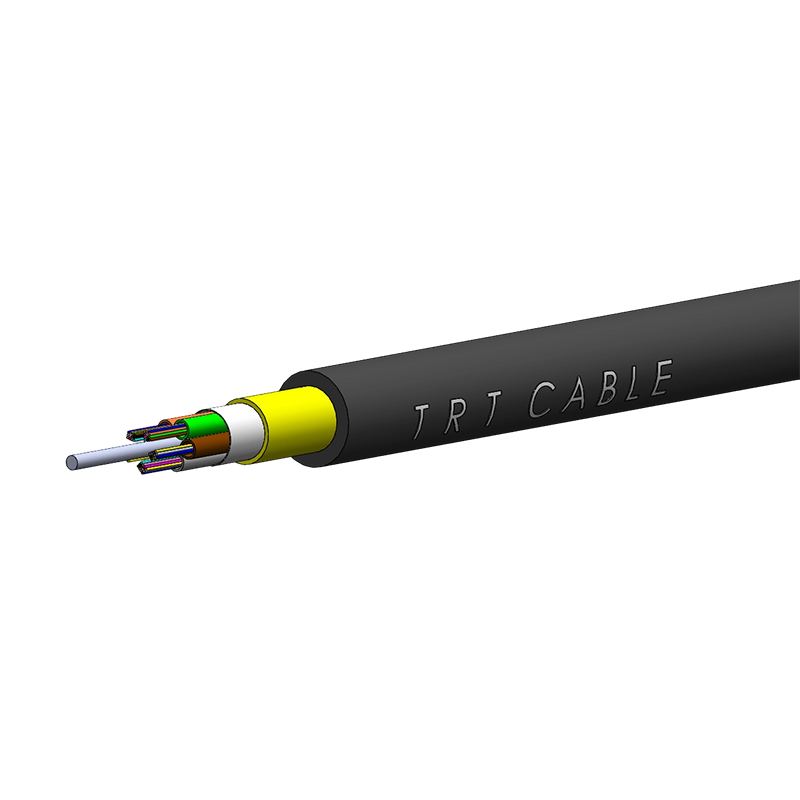
all-dielectric self-supporting outdoor fiber optic cable All-Dielectric Self-Supporting Outdoor Optical CableThis ADSS cable uses aramid yarn as strength members and a PE or LSZH jacket, enabling installation without power shutdown. Its light weight and long span capacity make it ideal for aerial routes, reducing tower loads and visual impact.View Product →
This product line is available in PE and anti-tracking sheath constructions, with fiber counts from 4 to 288 cores, covering most aerial backbone routes.
Core Structure of ADSS Fiber Optic Cable
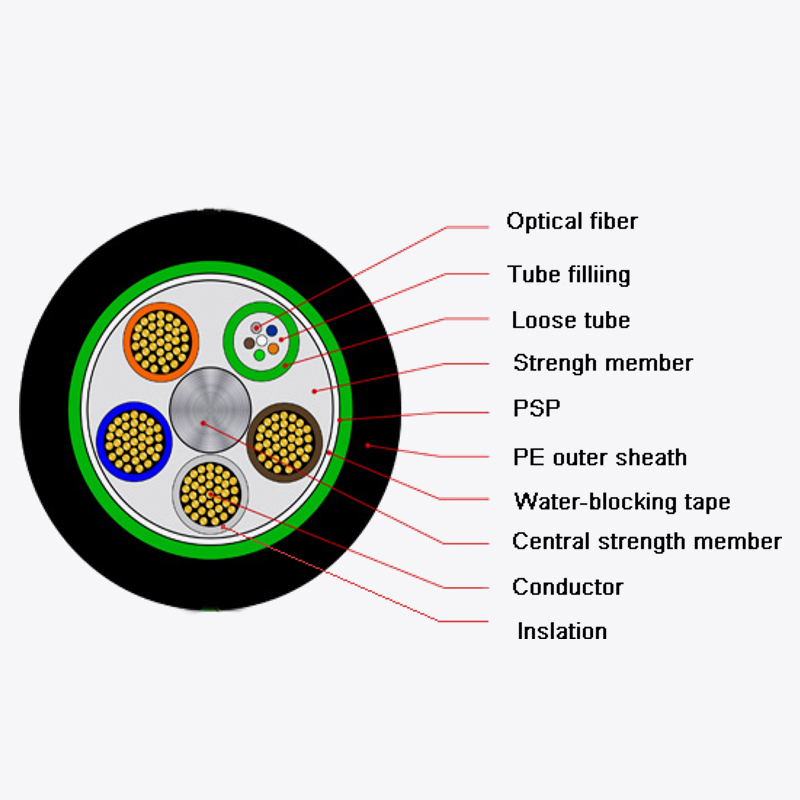
Understanding the layers of an ADSS cable helps you specify the right design and avoid field failures. From the center to the outer jacket, here is what you will find in a typical ADSS cable.
Key structural layers
- Optical fiber: Single-mode fibers such as G.652D or G.657A are placed inside loose tubes. The tube holds the fibers and is filled with a thixotropic jelly for water protection.
- Central strength member: A fiber-reinforced plastic (FRP) rod runs through the center, providing axial stiffness and preventing kinks. It is completely dielectric.
- Loose tube bundle: Several tubes are stranded around the central member. This allows the cable to bend without placing stress on the fibers.
- Water-blocking material: Swellable tape or yarn wraps around the core. When water enters, it expands and blocks the longitudinal passage of moisture.
- Aramid yarn: Laid helically over the core, the aramid yarn is the load-bearing element. Its quantity determines the cable's maximum tensile strength and allowable span.
- Outer sheath: Polyethylene (PE) or anti-tracking (AT) jacket protects the cable from UV, moisture, and electrical tracking.
PE sheath vs. anti-tracking sheath
| Comparison | PE Sheath | AT Sheath |
|---|---|---|
| Typical use | Telecom poles, low electric field | High-voltage corridors |
| Electrical tracking resistance | Standard | High |
| Induced voltage tolerance | Low | High |
| Cost | Lower | Higher |
Key Benefits of ADSS Fiber Optic Cable
The advantages of ADSS cable become obvious once you compare it to other aerial fiber optic options.
- No grounding required: Since there is no metal in the cable, there is no need for a grounding system. This simplifies design and saves labor.
- Electromagnetic immunity: ADSS is immune to induced currents from power lines. This prevents overheating, signal interference, and equipment damage.
- Self-supporting structure: The cable holds its own weight, so no messenger wire is needed. It can span distances of several hundred meters in one run.
- Lightweight handling: Without steel armor or a steel messenger, the cable is much lighter than comparable metallic reinforced cables, making field installation faster.
- Corrosion resistance: The all-dielectric construction eliminates the risk of rust, making it suitable for coastal and industrial environments.
- Compatibility with existing poles: You can often attach ADSS to poles and towers that are already shared with power lines, reducing the need for new infrastructure.
ADSS vs. Figure-8 and Other Aerial Cables
The most common alternative to ADSS is a figure-8 cable, which has an integrated steel messenger. Each option has its place, but they are not interchangeable in every environment.
| Feature | ADSS Cable | Figure-8 / Messenger Cable |
|---|---|---|
| Metallic components | None | Steel messenger |
| Grounding | Not required | Required |
| EMI risk | None | Susceptible |
| Installation | Single cable pull | Two-step or combined pull |
| Corrosion risk | None | Messenger can corrode |
| Best used | Near power lines, long spans | Short spans, existing messenger routes |
If you are comparing how different cables are built for indoor and outdoor routes, the indoor vs outdoor fiber optic cable structural differences explains how sheath and strength member choices affect installation performance.
How to Select the Right ADSS Fiber Optic Cable
Selecting the right ADSS cable is a matter of matching the cable design to the route, the environment, and the network requirements. Here are the variables that matter most.
Span length and sag
The distance between two support points determines the required tensile strength. Longer spans need more aramid yarn and a cable with higher maximum allowable tension. You also need to consider sag under wind and ice load, because real-world loading is not limited to the cable's own weight.
Fiber count and fiber type
Choose the core count based on demand, with room for growth. ADSS cables are available from 4 to 288 cores. For standard long-haul routes, G.652D is the usual choice. For bends and tight spaces, G.657A offers better bend performance.
Sheath type
Use a PE sheath when the cable will be installed on standard telecom poles where the electric field is low. Use an AT sheath when the cable runs next to high-voltage power lines and the induced voltage is high.
Environmental conditions
Check the operating temperature, UV exposure, and air quality. For coastal areas or industrial zones, the sheath material must be able to handle salt spray or chemical exposure.
Fit with hardware
ADSS is only as reliable as the hardware that holds it. Make sure the preformed dead-ends, suspension clamps, and vibration dampers are compatible with the cable outside diameter and rated tension.
A structured approach to specification makes project planning simpler. You can follow this fiber optic cable type selection guide to build a specification sheet that matches your route constraints.
ADSS Cable Installation Considerations
Installing an ADSS cable is a controlled pulling operation. The cable must not be damaged mechanically, and the final tension needs to match your sag calculations.
- Pulling tension: Use a tensioner that limits the pulling force to the cable's rated tensile strength. Never exceed the maximum allowed tension.
- Bend radius: Follow the manufacturer's minimum bend radius, typically about 20 times the cable diameter during installation and 10 to 15 times when the cable is at rest.
- Hardware: Use preformed wire dead-ends for the tension points, suspension clamps along the route, and vibration dampers in high-wind areas.
- Anti-twist: Prevent the cable from twisting during the pull. Twisting can damage the aramid yarn and break fiber strands.
- Clearance and spacing: Maintain proper separation from power conductors and other cables according to local utility standards.
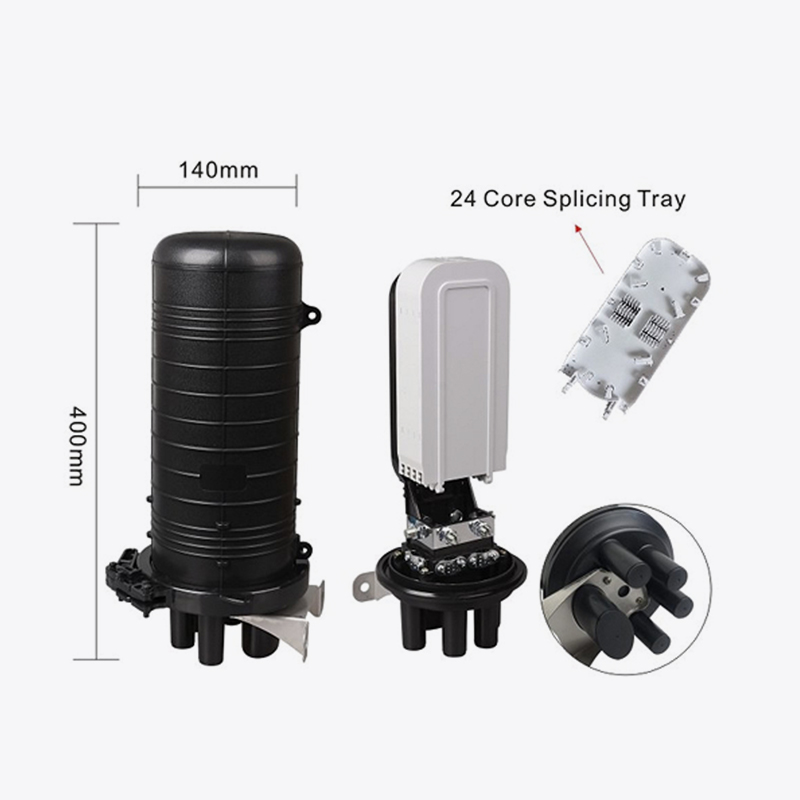 96-Core Heat-Shrinkable Fiber Optic Splice ClosureThis splice closure features a PP+GF body with one inlet and four outlets, using heat-shrinkable sealing for reliable protection. It suits medium-capacity aerial joints, safeguarding fusion splices from moisture and mechanical stress.View Product →
At every joint, a sealed enclosure protects the fusion splices from moisture and mechanical stress. A 96-core closure is a practical choice for medium-capacity aerial joints.
Frequently Asked Questions
Q1: What does ADSS stand for?
It stands for All-Dielectric Self-Supporting. The cable is made entirely of non-metallic materials and is designed to support its own weight between two support points.
Q2: Can ADSS cable be used near high-voltage lines?
Yes, as long as you select an anti-tracking (AT) sheath. The AT sheath protects the cable from electrical tracking and corona discharge in high electric field areas.
Q3: What span lengths can ADSS cable reach?
It depends on the rated tensile strength and the sag calculations. Most ADSS constructions handle spans of 100 meters to 800 meters, and special designs can exceed 1,200 meters.
Q4: Is ADSS more expensive than a figure-8 cable?
The cable itself is comparable in price, but the total installed cost is often lower because you avoid the messenger wire, grounding hardware, and a second pull.
 Address:Zhong'an Road, Puzhuang Town, Suzhou City, Jiangsu Prov., China
 Phone:+86-189 1350 1815
 Tel:+86-512-66392923
 Fax:+86-512-66383830
 Email:[email protected]
 Wechat: xiaobin18913501815
 whatsapp: +86 18913501815

 0
0