
 English
 русский
 Español
 Português
 عربى
عربى


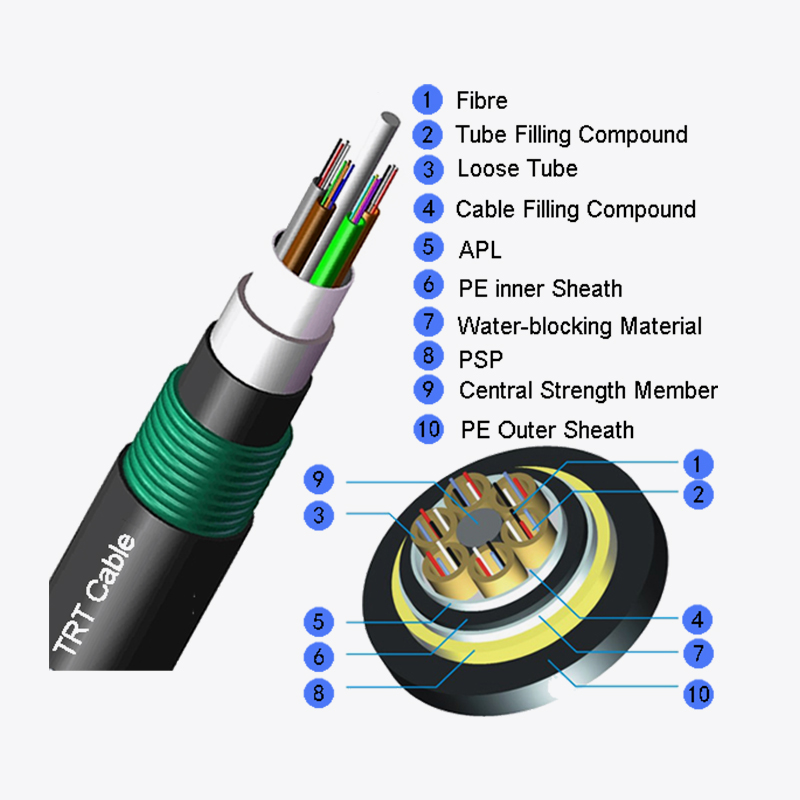
Fiber Optic Cable Cross Section: Core, Cladding, Strength Members, Jacket Layers
When you open a fiber optic cable datasheet, the first drawing you see is usually a cross-section. That circular image is not a formality. It is a compact map of everything that will happen to the light signal between the transmitter and the receiver. The layers in that cross-section determine how the cable bends, how much pulling tension it can handle, and whether it is safe to bury, aerial hang, or route through a data center tray.
In practice, you can make better buying decisions if you read that cross-section correctly. This guide explains what each layer does, how the design changes between indoor, outdoor, and FTTH cables, and which specifications matter most when you are comparing products.
What a Fiber Optic Cable Cross Section Shows You
A standard fiber optic cable cross-section, viewed from the end, shows five primary elements: the core, the cladding, the coating, the strength members, and the outer jacket. Each one has a different job, and each one adds thickness and cost.
The core is the glass or plastic path where light travels. The cladding surrounds the core and keeps the light inside by creating a lower refractive index. The coating is a soft buffer that protects the glass from micro-bending. The strength members, such as aramid yarn or steel wire, provide tensile support. The jacket is the outermost layer that protects against moisture, abrasion, and chemical exposure.
A cross-section is not just a picture. It is a specification summary that tells you how the cable will behave under bending, pulling, and environmental stress.
When you look at a cross-section drawing, you can quickly see how many fibers are packed inside. A six-fiber cable will show six concentric circles, while a 144-fiber cable may show multiple loose tubes or a ribbon stack. The drawing also reveals the cable's diameter, which matters when you are selecting duct size or routing space in a cabinet.
Core and Cladding: The Light Path
The core and cladding are the two layers that define the optical performance of the cable. In a single-mode fiber, the core is typically 9 µm, while the cladding is 125 µm. In multimode fiber, the core is either 50 µm or 62.5 µm, with the same 125 µm cladding.
This size difference is why the cross-section of a single-mode fiber looks almost solid at 125 µm, while a multimode fiber has a more visible inner circle. The cladding's refractive index is slightly lower than the core's, which forces the light to stay in the core through total internal reflection. For signal attenuation, the core-to-cladding concentricity and the cladding diameter uniformity are both critical. If you are hunting for a low-loss patch cord or a cable for long-distance transmission, the cross-section will show whether the manufacturer uses a standard 9/125 geometry.
For short-distance runs in data centers, the larger core of multimode fiber is easier to couple and offers more tolerance to installation error. The cross-section of a typical multimode cable will look similar, but the core area is significantly larger.
Strength Members and Jacket Layers: What Protects the Fiber
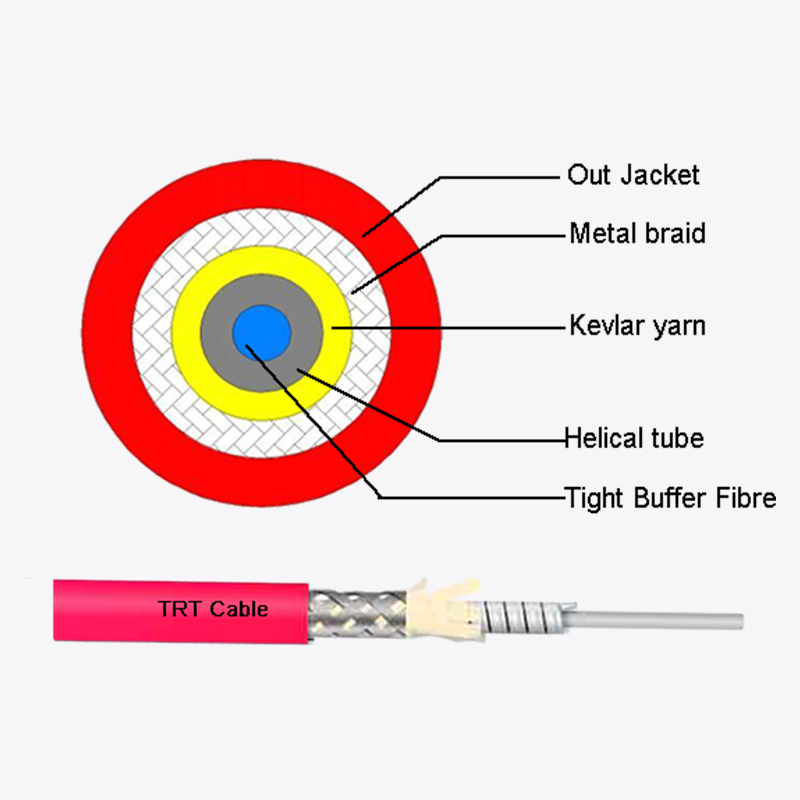
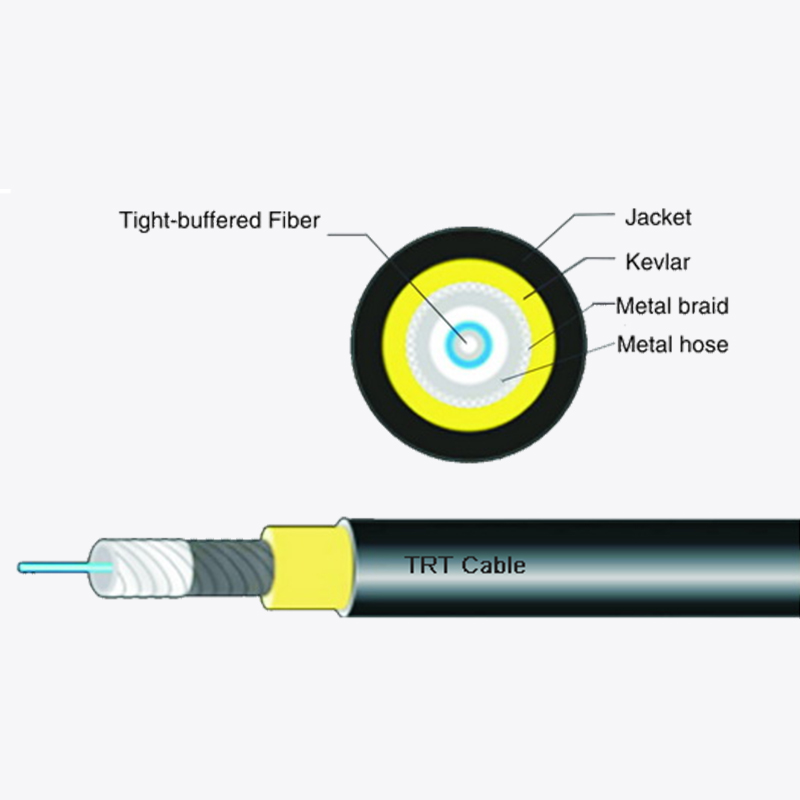
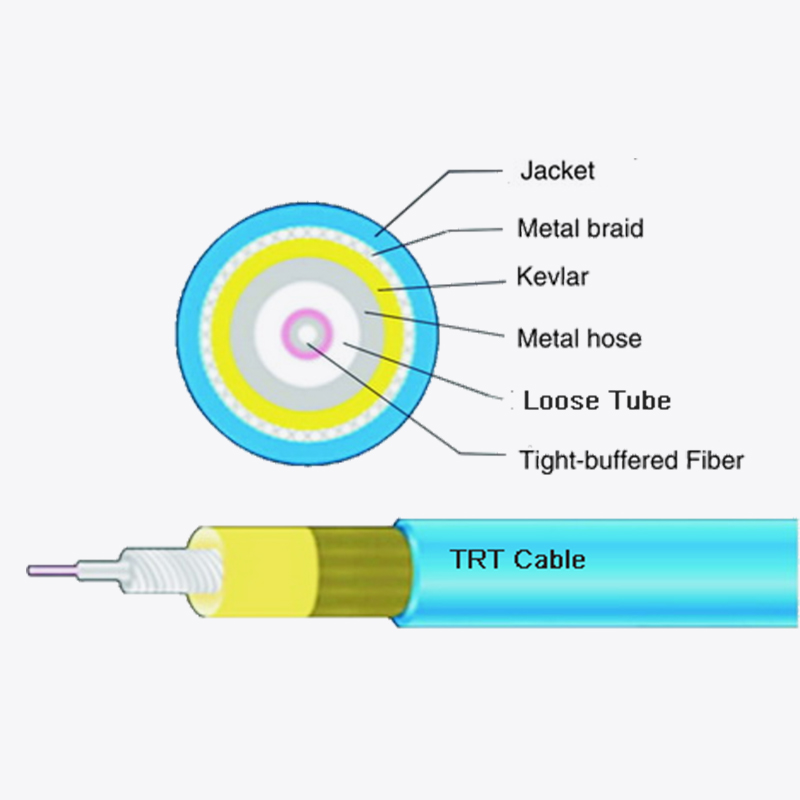
Outside the coated fiber, the next ring in the cross-section is the strength member, and it changes depending on the installation environment. Indoor cables often use aramid yarn (Kevlar) to resist pulling. Outdoor cables may use steel wire or a fiber-reinforced plastic (FRP) rod as a central strength member. Armored versions add a corrugated steel tape or a flexible metallic armor between the core and the jacket.
The jacket layer is equally important. A standard indoor cable uses a flame-retardant LSZH (low smoke zero halogen) jacket. An outdoor cable may use a polyethylene (PE) jacket that is resistant to UV and moisture. If you compare the cross-section of an armored outdoor cable to a standard patch cord, the difference is obvious: the armored cable has a thicker wall, a bedding layer, and a metal armor ring.
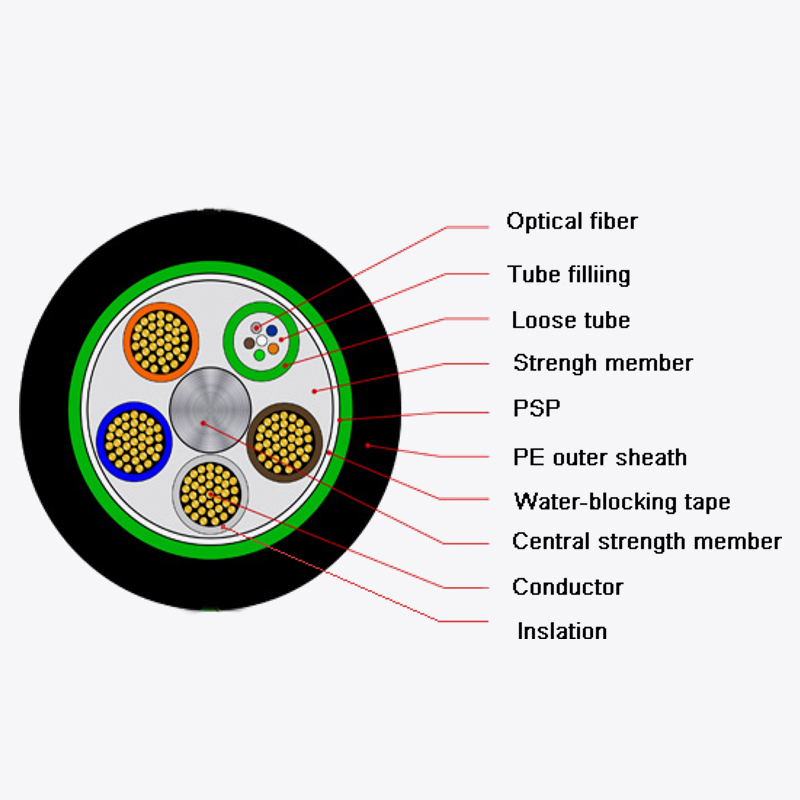
When you see a product like stranded loose tube armored cable, the cross-section will show a central strength member, loose tubes around it, and a corrugated steel tape under the outer jacket. That design is what makes it suitable for direct burial and harsh environments.
 Stranded Loose Tube Armored Cable GYTA53 for Direct BurialThis cable features a central steel strength member, loose tubes with water-resistant filling, and a corrugated steel tape under a PE outer sheath. Its construction provides crush resistance and watertightness, making it suitable for harsh outdoor environments.View Product →
Common Cross Section Designs for Indoor and Outdoor Cables
Different cable types use different cross-section layouts. The table below compares the most common designs you will encounter when selecting fiber optic cable.
| Cable Type | Typical Cross-Section Layout | Key Layer(s) | Best Use |
|---|---|---|---|
| Tight-buffer indoor | Fiber with tight buffer coating directly over the cladding | PVC or LSZH jacket | Patch panels, data center, building distribution |
| Loose tube outdoor | Loose tubes around a central strength member | Gel filling, PE jacket | Outdoor duct, aerial, long-distance |
| Armored outdoor | Loose tube core with corrugated steel tape armor | Steel armor, PE jacket | Direct burial, rodent protection |
| Butterfly drop cable | Bow-type shape with two FRP or steel strength members | LSZH or PVC jacket | FTTH drop, indoor/outdoor transition |
The tight-buffer indoor cable is easier to terminate because the fibers are fixed in position. A 24-fiber micro indoor cable uses a compact cross-section that fits in small conduits, making it a good choice for high-density building risers.
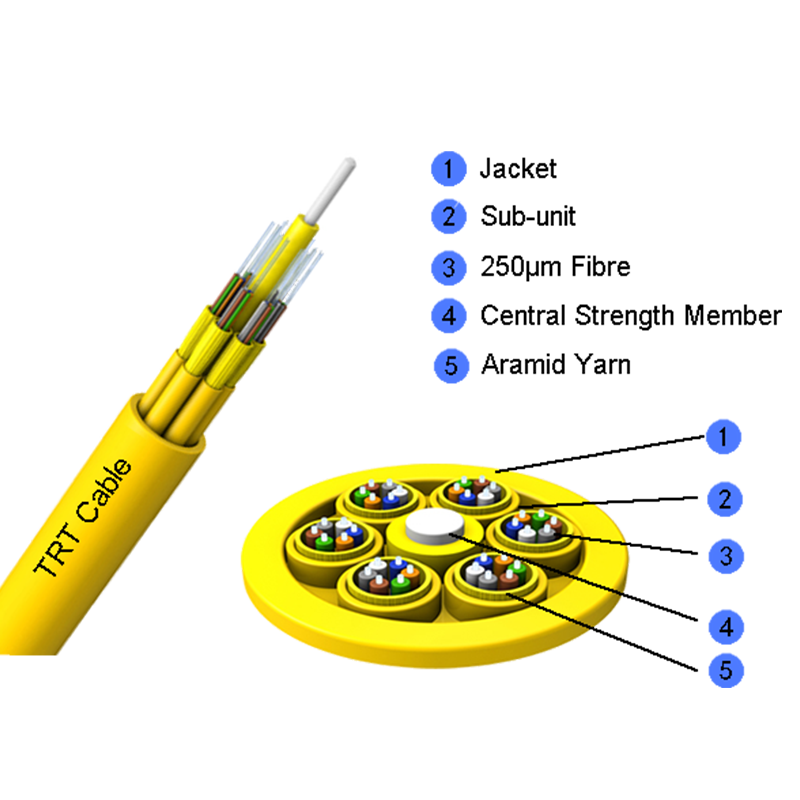 Micro Fibre Indoor Cable with 24 or More FibersDesigned for high-density building risers, this compact cable uses FRP central strength member and aramid yarn, with options for PVC or LSZH jacket. It offers easy termination and fits small conduits, providing reliable indoor distribution.View Product →
What to Compare When You Are Specifying a Cable
When you compare two cable cross-sections, focus on a few specific values rather than the overall look. First, check the fiber count and the cable diameter. A high fiber count inside a small diameter can mean the cable is packed tightly, which reduces bend performance. Second, check the minimum bend radius. This is usually the outer diameter multiplied by a fixed factor, such as 10x for indoor cable or 20x for outdoor loose tube cable. Third, look at the jacket material and whether the cross-section shows any water-blocking tape, gel, or moisture barrier.
For FTTH drops, the cross-section of a butterfly drop fiber optic cable is recognizable by its flat, bow-type shape with two strength members on the ends. That geometry allows the cable to be pulled through small ducts and stapled to walls without kinking. The flat side also helps installers identify orientation under the jacket.
Buyers should also verify whether the cable is suitable for the local fire code. In an indoor environment, an LSZH jacket may be mandatory. In an outdoor environment, a UV-stabilized PE jacket is more important.
How Reading the Cross Section Helps You Avoid Installation Problems
In the field, most fiber optic problems come from bending and compression. A cross-section tells you how much buffer, strength member, and armor stand between the fiber and the outside world. For example, a cable with only a thin coating and no strength member may pass light before installation but fail after being pulled through a horizontal duct.
When you see a cable with water-blocking tape in the cross-section, you know it is designed for wet or humid environments. When you see a metallic armoring layer, you know it can survive rodent attacks. When you see a flat, bow-type profile in a drop cable, you know it is designed for fast FTTH aerial or wall mounting.
The cross-section also helps you predict cable assembly work. If the fibers are in loose tubes, you need to prepare for gel cleanup and careful tube handling. If the fibers are tight-buffered, stripping and connector installation are quicker. For high-density data centers, a structural guide to fiber optic cable can help you map these design choices to the right deployment strategy.
Frequently Asked Questions About Fiber Optic Cable Cross Sections
Q1: What does a fiber optic cable cross section show?
It shows the core, cladding, coating, strength members, and jacket. In some cables, it also shows loose tubes, water-blocking tape, or metallic armor. These layers together determine the cable's performance and installation suitability.
Q2: Why is the core-to-cladding ratio important?
The ratio determines how light is confined in the fiber. A 9/125 µm single-mode fiber has a small core, which supports long-distance transmission. A 50/125 µm multimode fiber has a larger core, which is easier to couple and is common in data centers.
Q3: How can I tell if a cable has water protection from the cross-section?
Look for a filler gel or a water-blocking tape layer around the loose tubes or around the cable core. These elements appear as an extra ring in the cross-section drawing and indicate that the cable is designed for outdoor or humid environments.
Q4: Does more armor always mean better cable?
Not necessarily. Armored cable is stronger and more rodent-resistant, but it is also stiffer, heavier, and harder to terminate. For indoor patch cords, a light tight-buffer design is better because it is more flexible and easier to install.
Reading a fiber optic cable cross-section is a practical skill. It helps you compare products quickly, avoid installation failures, and communicate with suppliers about precisely what you need. Whether you are building a long-distance backbone, an FTTH drop network, or a data center cabling system, the cross-section is the single drawing that reveals whether the cable will do its job.
 Address:Zhong'an Road, Puzhuang Town, Suzhou City, Jiangsu Prov., China
 Phone:+86-189 1350 1815
 Tel:+86-512-66392923
 Fax:+86-512-66383830
 Email:[email protected]
 Wechat: xiaobin18913501815
 whatsapp: +86 18913501815

 0
0