
 English
 русский
 Español
 Português
 عربى
عربى


Fiber Optic Duplex Cable Guide: Types, Specifications, and Buying Tips
What Is a Fiber Optic Duplex Cable?
A fiber optic duplex cable contains two individual optical fibers in one jacket or as a paired assembly. The two fibers provide two separate optical paths, which is exactly what standard transceivers need: one path for transmitting, one for receiving. This is why duplex cables are the default choice for Ethernet, storage-area networks, and most FTTH drop connections.
Every standard SFP, SFP+, and QSFP module uses separate transmit and receive lanes. A duplex cable gives you the physical pair those modules expect. When you plug a module into a switch port, you are connecting to two fiber ports: one labeled TX and one labeled RX. A duplex cable completes both in a single pull.
Duplex is not a feature upgrade. It is the standard physical layer for two-way fiber communication.
Simplex vs. Duplex: What Changes in Practice?
A simplex fiber optic cable has only one strand and supports one-way transmission. You can still achieve two-way communications on a simplex cable with BIDI transceivers, because BIDI modules use different wavelengths and internal filtering. For almost everything else, a duplex cable is simpler, more reliable, and easier to test.
| Feature | Simplex | Duplex |
|---|---|---|
| Fiber strands | 1 | 2 |
| Direction | One-way | Bidirectional, TX and RX separate |
| Transceiver match | BIDI SFP / CWDM | Standard SFP / SFP+ / QSFP |
| Common uses | Video links, sensors, long-haul WDM | Data centers, LAN, enterprise, FTTH |
| Installation | Single drop | Two strands, more planning margin |
The practical effect is straightforward. If your device has two optic ports labeled TX and RX, a duplex cable is the correct fit. If your device has one port and a BIDI transceiver, a simplex cable can work. Most switch-to-server connections in a data center use the two-port style.
Common Duplex Cable Types
Duplex cables come in several constructions. The jacket, the fiber, and the armor layer determine where a cable can be used.
Zipcord and Round Indoor Duplex Cable
Zipcord duplex cable has two tight-buffered fibers in a figure-eight jacket. It is lightweight, flexible, and easy to terminate, which makes it the standard for short patch cords and equipment jumps inside a rack. Round duplex indoor cable places the two fibers in a circular jacket with aramid yarn for strength. It is the choice for longer indoor runs, riser paths, and cable trays.
For premises links and equipment connections, a zipcord interconnect cable is a good fit. TRTCABLE's zipcord interconnect fiber optic cable uses two tight-buffered fibers for clean termination and a small bend radius.
Zipcord Interconnect Fiber Optic Cable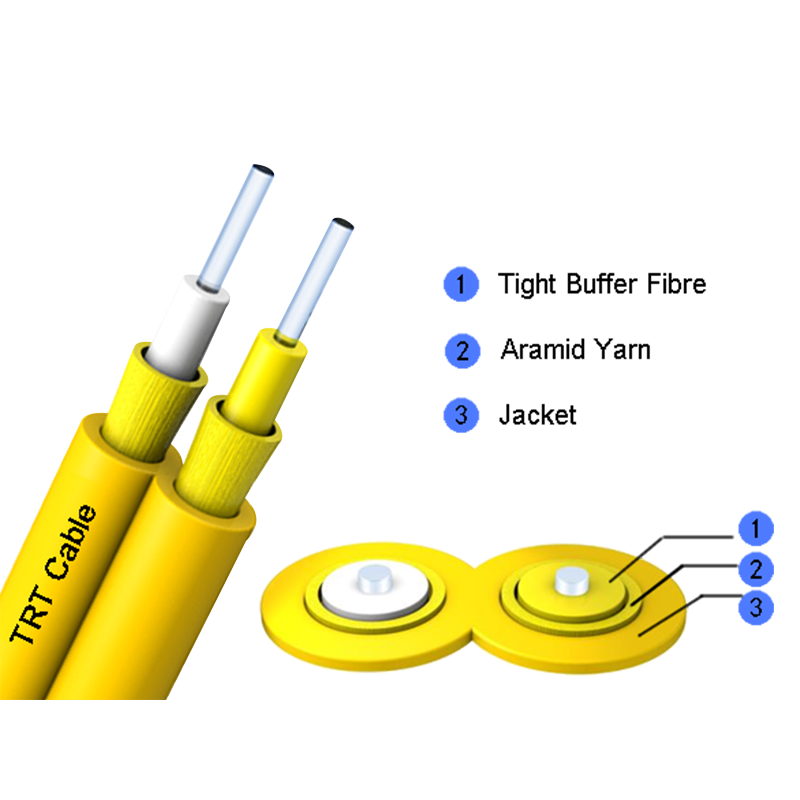 Zipcord Interconnect fiber optic cable GJFJBZipcord Interconnect cable use 900μm or 600μm flame-retardant tight buffer fiber as optical communication medium. The tight buffer fiber wrapped with a layer of aramid...View Product →
Armored Duplex Cable
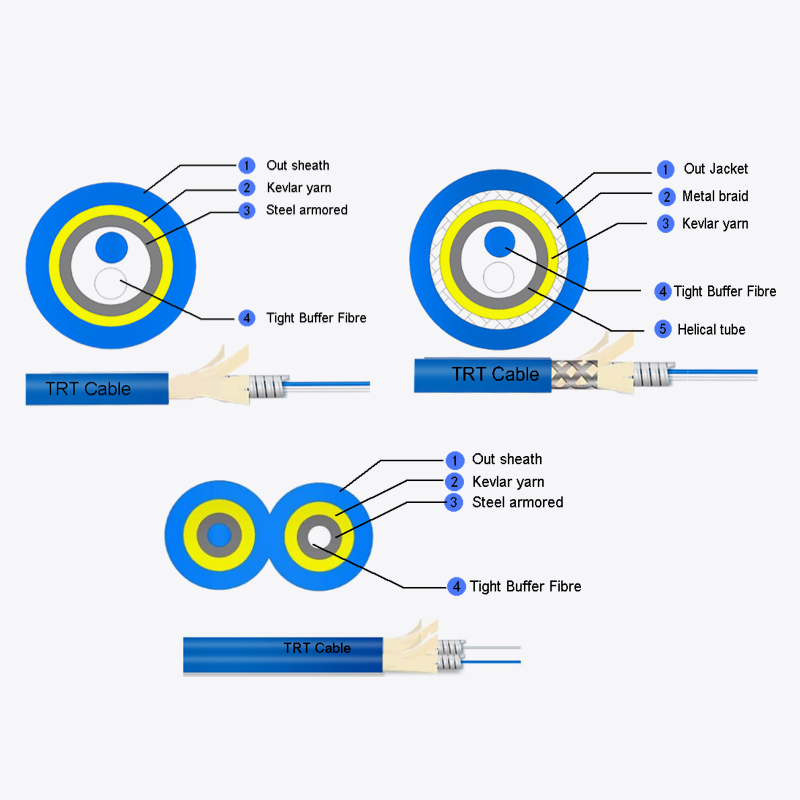
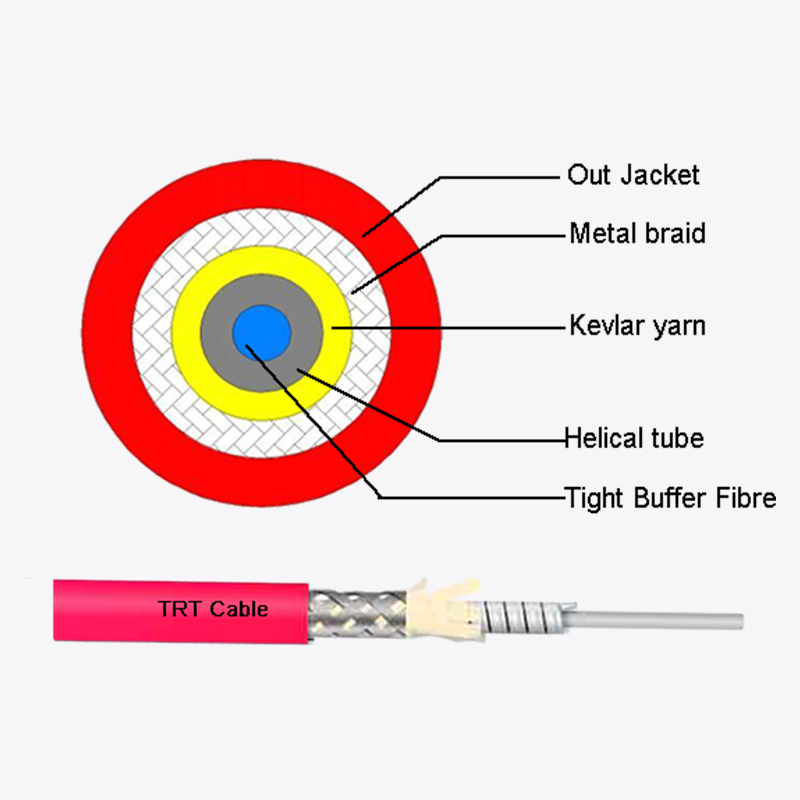
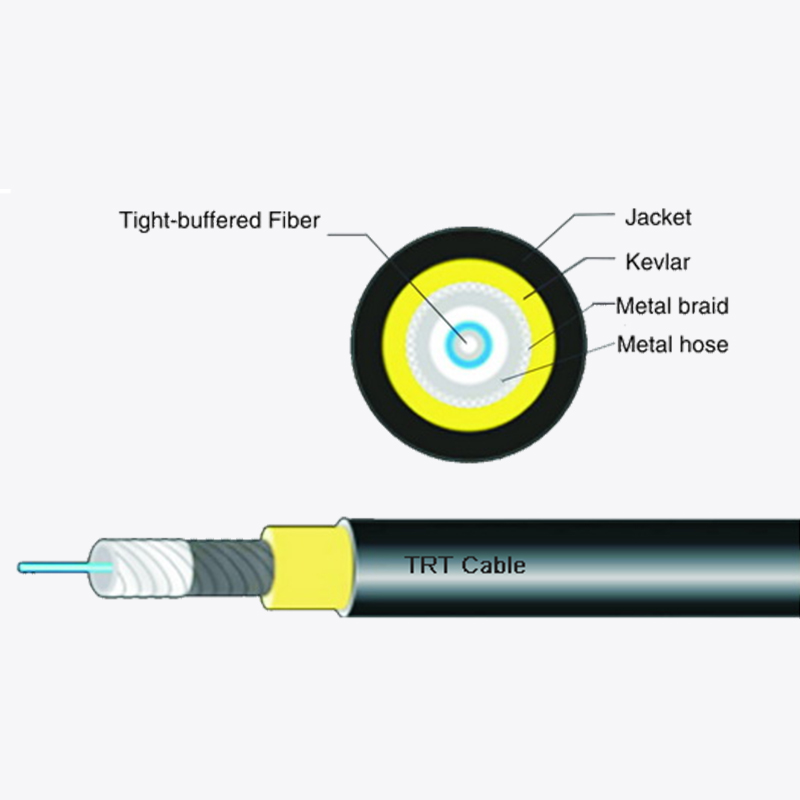
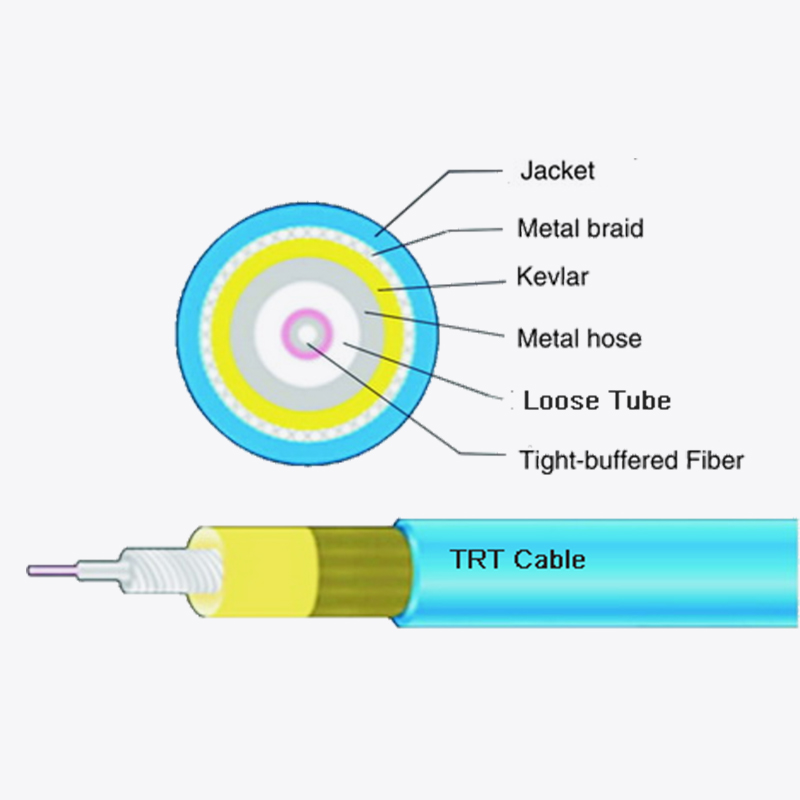
In a machine room, factory, or exposed ceiling, a metal or spiral armor layer protects fibers from crush, rodent damage, and accidental impact. Armored duplex cables keep the two-fiber pairing while adding a decisive protective shell.
For environments where physical damage is a real risk, TRTCABLE's duplex round armored cable adds a protective layer without sacrificing flexibility.
Duplex Round Armored Cable Duplex Round Armored Cable● Used in pigtails and patch cords.View Product →
Duplex Patch Cords
A duplex patch cord is a pre-terminated duplex cable with connectors already installed and tested at the factory. The most common connector is LC, because LC is the interface standard for SFP and SFP+ modules. SC, FC, and ST duplex patch cords are still used in specific equipment and cable plants.
Connector Choices for Duplex Cables
The connector is the most user-visible decision. It determines which transceiver, panel, or splice tray you can connect to.
LC, SC, FC, and ST
LC duplex connectors place two ferrules side by side in one small clip. They are the de facto standard for modern Ethernet and fiber-channel gear. SC duplex connectors are square and larger, common in FTTH and older rack-mounted hardware. FC connectors are round and threaded, often used in test equipment. ST connectors use a bayonet twist lock and appear in legacy local-area networks.
If you are standardizing a data-center or enterprise link, an LC-LC duplex patch cord is the safest starting point. TRTCABLE's LC-LC duplex fiber optic patch cord is designed for SFP and SFP+ transceivers.
LC-LC Duplex Fiber Optic Patch Cord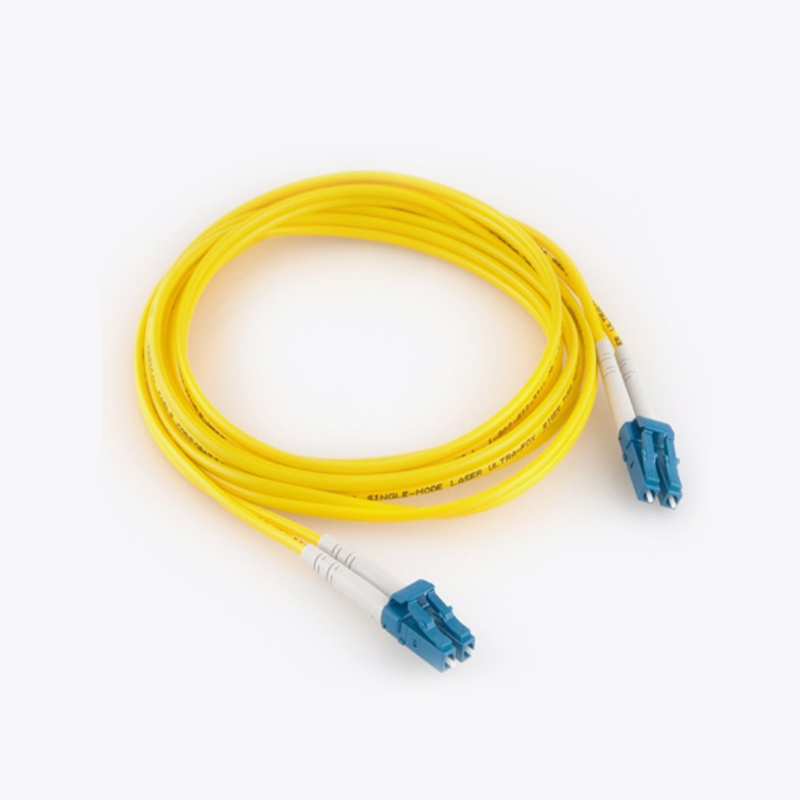 LC to LC Duplex Fiber Optic Patch Cord for High-Speed Network ConnectivityThe LC to LC Duplex Fiber Optic Patch Cord for High-Speed Network Connectivity is a precision-engineered fiber cable designed to support high-bandwidth data transmissi...View Product →
If you need to compare more connector options, TRTCABLE's guide on choosing the right fiber optic patch cord walks through the selection criteria step by step.
Polish and Performance
Connector polish affects return loss. UPC polish is fine for most digital links. APC polish, with its angled end-face, reduces back reflection and is preferred for analog or high-power applications. For most duplex data links, UPC is sufficient.
Specifications to Check Before You Buy
The table below lists the core specifications to compare when you order a duplex fiber optic cable.
| Specification | What it means | Typical values |
|---|---|---|
| Fiber type | Single-mode vs multimode | OS2, OM3, OM4 |
| Cable diameter | Outer jacket thickness | 2.0 mm, 3.0 mm patch cord |
| Jacket material | Flame and smoke rating | PVC, LSZH, Plenum |
| Bend radius | Minimum safe bend | 10x / 20x cable diameter |
| Attenuation | Signal loss per kilometer | 0.4 dB/km OS2, 3.0 dB/km OM3 |
| Connector polish | End-face geometry | PC, UPC, APC |
Attenuation and bend radius are the two numbers that actually change performance. OM3 supports 10 Gbit/s up to about 300 m. OS2 supports much longer distances, but it requires careful connector alignment. For runs under 100 m inside a rack, multimode is usually enough. For outdoor or campus backbone runs, single-mode is the safer choice.
Where Duplex Cables Are Used
Duplex cables appear in nearly every part of a fiber network. Data Center Enterprise FTTH Outdoor
Data Centers and Server Rooms
Server-to-switch, switch-to-switch, and storage links all use duplex fiber. SFP+ and QSFP modules have separate TX and RX lanes. A duplex cable is the physical connection that completes the pair. In high-density racks, LC duplex patch cords plug into cassette panels or MPO breakouts.
Enterprise Buildings
In an office, a duplex cable runs from an access switch to a work-area outlet or from the main distribution frame to a floor distribution frame. Indoor zipcord and round duplex cables are the usual choices for horizontal and backbone links.
For more background on how indoor duplex and other fiber types behave inside a building, TRTCABLE has an article on indoor fiber optic cables.
FTTH and Broadband Access
In FTTH, duplex cable still plays a role. Many ONTs have two optical ports, one for an incoming feed and one for an optional return or redundancy link. Duplex can also support future service upgrades that need a second fiber path.
Frequently Asked Questions
Q1: What is a duplex fiber optic cable?
A duplex fiber optic cable contains two fiber strands in one assembly. It provides two separate optical paths, typically one for transmitting and one for receiving.
Q2: Can I use a simplex fiber cable instead of a duplex cable?
Only if your transceivers are BIDI type, which use two wavelengths on one fiber. For standard SFP, SFP+, and QSFP modules, you need a two-fiber duplex cable.
Q3: What is the difference between OM3 and OS2 duplex cables?
OM3 is a multimode fiber designed for short distances, typically up to a few hundred meters. OS2 is a single-mode fiber that supports much longer links, but it requires better connector alignment and usually costs more per cable assembly.
Q4: Can I run a duplex cable outdoors?
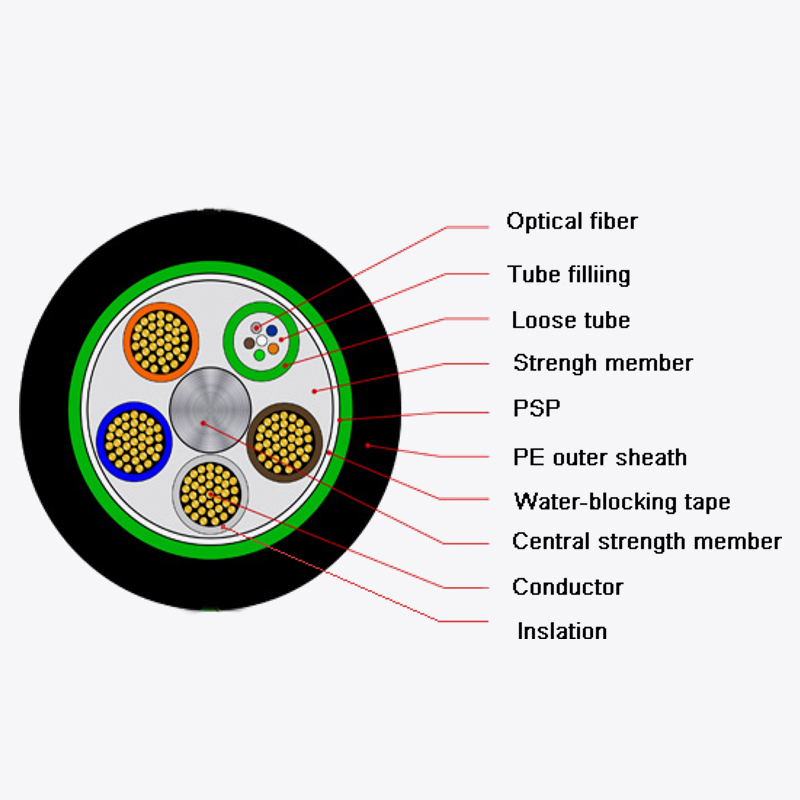
Yes, but you need an outdoor-rated jacket, usually with a water-blocking or armored construction. Indoor duplex cables should not be used in ducts or underground without extra mechanical and moisture protection.
Which Duplex Cable Should You Buy?
Start with the connector type on your equipment. Most modern networking gear uses LC. Then check the fiber type. For links under 300 m in a data center, OM3 or OM4 multimode is usually enough. For longer runs, outdoor, or unknown distance, choose OS2 single-mode.
Next, look at the physical environment. An indoor zipcord cable is fine for a clean server room. A round duplex or armored version is better for a machine room, exposed ceiling, or rough environment. Finally, verify the jacket. LSZH is common in Europe and indoor spaces where smoke emission matters. Plenum-rated jacket is required in many North American air-handling spaces.
Still unsure? Shortlist two or three cables, match the connector and fiber type to your transceivers, and confirm the rated bend radius for your installation path. That is the fastest way to avoid return loss, high insertion loss, or connection failure after installation.
 Address:Zhong'an Road, Puzhuang Town, Suzhou City, Jiangsu Prov., China
 Phone:+86-189 1350 1815
 Tel:+86-512-66392923
 Fax:+86-512-66383830
 Email:[email protected]
 Wechat: xiaobin18913501815
 whatsapp: +86 18913501815

 0
0