
 English
 русский
 Español
 Português
 عربى
عربى


Fiber Optic Cable Management: Routing, Protection and Organization Guide
A field technician opens a 144-core splice closure after six years of service and finds the slack loops compressed under their own weight. The OTDR trace shows a 1.2 dB attenuation increase at that point. The splices are fine; the cable management is not.
Fiber optic cable management is the discipline of routing, bending, storing, and protecting optical fibers so that loss stays stable, faults stay findable, and capacity stays usable. It directly affects your network loss budget, your maintenance cost, and your ability to expand later. TRTCABLE manufactures the passive infrastructure that supports this discipline, and this guide explains the rules and hardware decisions that keep fiber networks within specification for years.
Good cable management is invisible when it works and unmistakable when it fails: an OTDR trace is the honest judge.
Why fiber optic cable management affects your loss budget
Optical loss is rarely caused by the fiber itself. It is caused by how the fiber is bent, compressed, and terminated. Three physical mechanisms dominate:
- Macrobending: when a fiber is bent beyond its minimum radius, light escapes the core and loss rises sharply. A single tight loop can add several decibels of attenuation in a standard G.652 cable.
- Microbending: point pressure from a cable tie, a clamp, or a cable stacked on top of another deforms the core and causes small but often temperature-sensitive losses.
- Mechanical stress: tension on pigtails, splices, or connectors changes optical alignment and can turn into failures after thermal cycling.
10x / 20x
Minimum static / dynamic bend radius as multiples of cable outer diameter for most standard cables.
1 dB
A single uncontrolled bend can consume a large part of a typical link loss budget.
TIA-606-B
Administration standard for labeling every cable, termination, and connection point.
Every management decision is therefore a budget decision. A well-designed link can still fail its loss budget if one closure is packed with kinked fibers.
Core rules for planning fiber optic cable management
These five rules apply to every fiber installation, from a two-fiber drop to a 576-core cabinet.
Control the bend radius at every point
In trays, turnbacks, raceways, and behind patch panels, the fiber must never be forced around a corner. The table below gives typical reference values; the manufacturer datasheet always wins.
| Cable category | Static bend radius | Installation bend radius | Short-term tension limit |
|---|---|---|---|
| Indoor tight-buffer | 10x OD | 20x OD | 80-150 N |
| Outdoor loose-tube | 10x OD | 20x OD | 600-1,500 N |
| Bow-type drop cable | 15x OD | 20x OD | 80-120 N |
| Armored cable | 15x OD | 25x OD | 1,000-2,000 N |
Store slack deliberately, not loosely
In splice closures and distribution boxes, route each fiber into its designated tray and fix the loops so they cannot unroll under gravity or vibration. A common requirement is around 1 m of slack per fiber side for re-splicing, but the tray geometry must keep the fiber above its minimum bend radius while the tray is closed.
Label what will need to be found later
Follow the TIA-606-B administration standard: machine-printed labels at both ends and at every joint, with closure or box identifiers, and record every change in as-built documentation. Unlabeled fiber is unsupportable fiber.
Separate fiber from power and protect the transitions
In cable trays, keep unshielded power at least 100 mm (about 4 inches) away from data fiber, and use a metal separator if the power load is high. Protect every wall entry, cabinet gland, and closure port with the correct grommet or sealing grade.
Respect pulling forces
Pull on the cable jacket, never on the fiber or strength members alone, and use a tension limiter where the route is long. Exceeding the short-term tensile rating will show up months later as increased loss at the stress points.
Selecting the right hardware for organized fiber networks
The cable is only as well managed as the boxes and cabinets that contain it. Three product families cover most management points in a network.
Splice closures for outside plant
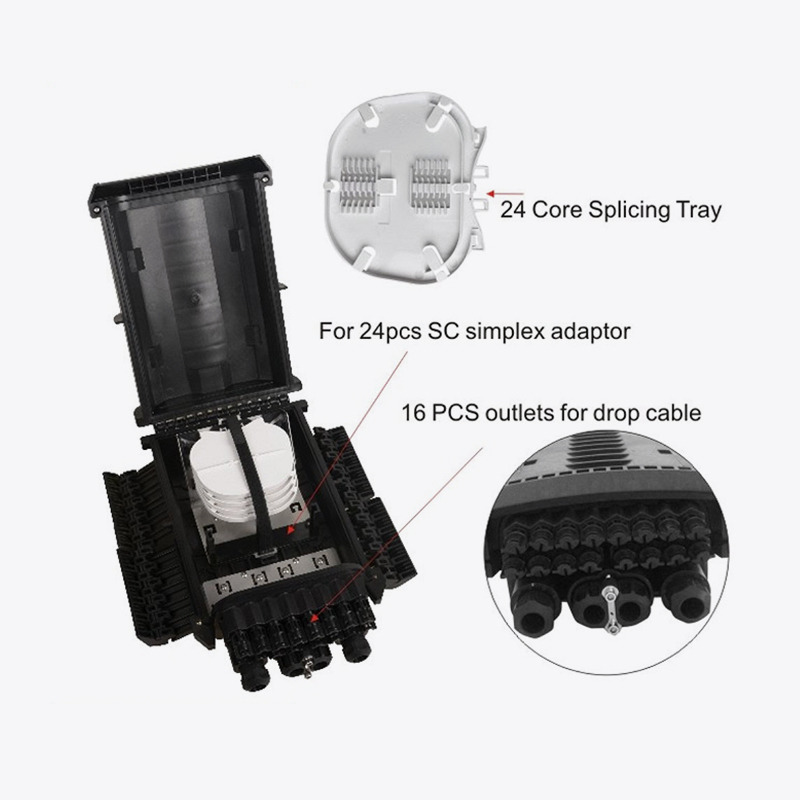
A splice closure is where cables join, and it is where management mistakes are most expensive. Look for closures with separate slack storage, stackable splice trays, and cable entry ports that keep incoming and outgoing fibers inside the recommended bend radius.
 288-Core Splice Closure with Stackable Trays and Sealed PortsThis large-capacity closure offers generous slack storage, stackable splice trays, and a mechanical seal rated IP68, making it a reliable choice for backbone spans where repeated re-entry and cable management matter.View Product →
Our 288-core closure for large backbone spans illustrates these features: generous slack capacity, stackable trays, and a sealing system that supports repeated re-entry. For a wider discussion, see our article on how splice closure and cabinet systems keep long-distance networks in service.
FTTH distribution boxes for the access network
A distribution box is the branching point where a feeder or distribution cable splits into multiple drops. The box stores splices, holds splitter or pigtail connections, and routes drop cables to separate ports while protecting the exposed fibers.
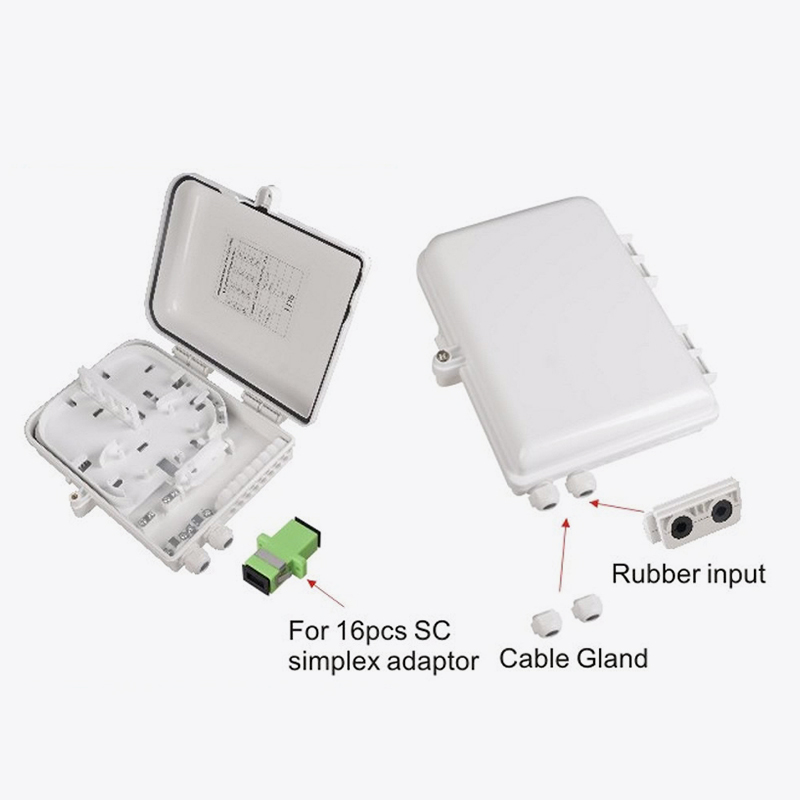 16-Core FTTH Distribution Box with Splice and Adapter FunctionsA compact ABS distribution box that combines splicing, adapter mounting, and cable fixing in a single IP65-rated enclosure, suited for branching feeder cables into multiple drop lines while protecting exposed fibers.View Product →
The 48-core distribution box from our FTTH range is a practical example: it combines splicing, adapter, and cable-fixing functions in one enclosure sized for networks that expect growth.
Cabinets and terminal boxes for concentrated density
Building risers, data centers, and telecom rooms terminate hundreds of fibers in one location. Cabinets provide organized adapter banks, slack routing, and locking in protected enclosures; terminal boxes handle one- to eight-fiber end points in small rooms and offices.
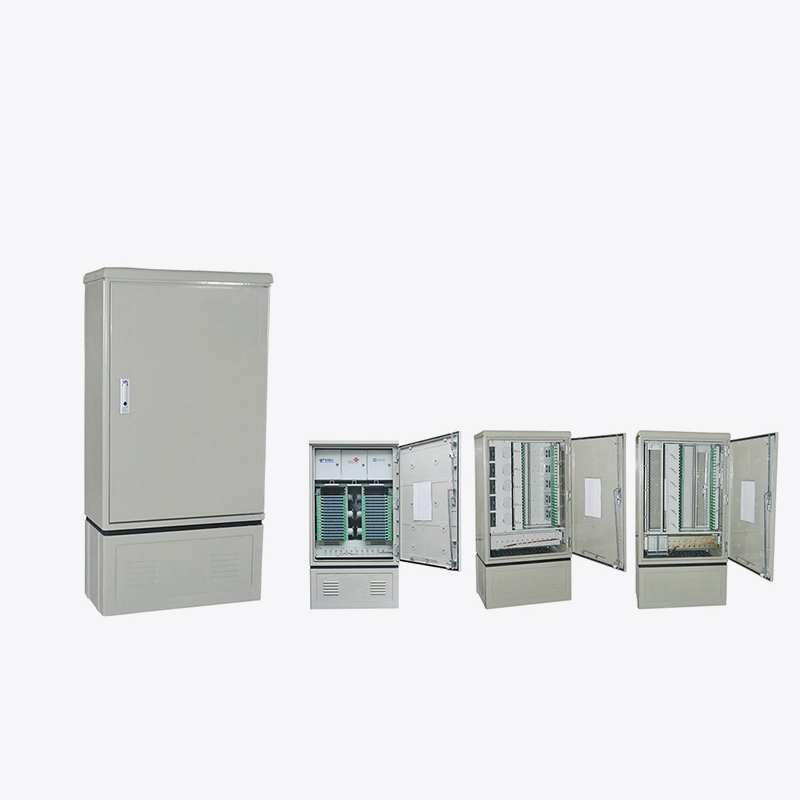 576-Core Outdoor SMC Cabinet for High-Density Fiber TerminationThis SMC outdoor cabinet centralizes backbone, distribution, and patch connections in a large 576-core capacity, keeping slack organized and preventing tangles in demanding telecom rooms and data center environments.View Product →
For high-density sites, a 576-core SMC cabinet centralizes backbone, distribution, and patch connections without letting slack turn into a tangle.
Managing fiber cables by deployment scenario
Management rules stay the same, but hardware priorities shift with the environment.
FTTH and access networks
Drops are short, so bend issues are local: pull slack gently, loop it with a radius guide, and protect the transition from outdoor to indoor with an FTTH box. Fast termination only helps if the slack is reserved for re-termination later.
Outdoor backbone and feeder routes
High fiber counts, long spans, and weather put the focus on closures with generous slack storage and sealing rated for the installation type. For underground routes, pair the closure with armored or water-blocked cables.
Data centers and telecom rooms
Density changes the problem: high fiber counts in tight space, frequent moves, and cooling airflow. Use cabinets and patch panels that route trunks and jumpers in separate channels, and leave dedicated slack loops accessible without bending the fiber past its limit.
What to verify before buying cable management hardware
Cable management hardware is expensive to replace. Verify these seven points before you commit to a product family.
- Capacity headroom: choose fiber counts with at least 20-30% spare capacity; a 48-core box can feel full sooner than expected.
- Port and adapter compatibility: SC, LC, or hybrid configurations must match your pigtails and drop cables.
- IP rating: IP65 covers dust and water jets for outdoor wall units; IP68 is needed for buried or manhole positions.
- Material: SMC resists impact and weathering better than ABS for heavy outdoor use; polypropylene closures suit sealed underground locations.
- Slack storage geometry: verify that the tray layout respects the fiber bending radius and that the tray count matches the planned splice count.
- Re-entry design: clamped closures are easier to re-enter than fully bonded ones; ask how many times the seal can be opened.
- Accessory supply: pigtails, adapters, splice protectors, and fixing kits should come from the same source to avoid fit problems.
Cable management FAQ
Q1: What is the minimum bend radius for fiber optic cable?
For most standard cables, keep the static bend radius at or above 10 times the cable outer diameter and 20 times during installation. Armored and high-count cables may require 15 times or wider. Bend-insensitive G.657 drops tolerate tighter bends, but check the datasheet before relying on it.
Q2: How much slack should be stored in a splice closure or distribution box?
Enough to allow each fiber to be removed and re-spliced without pulling neighboring fibers out of their trays; about 1 m of slack per side is a common working standard. The total must fit in the closed tray without exceeding the minimum bend radius.
Q3: Can I use cable ties on fiber optic cables?
Standard zip ties are not recommended. The point pressure creates micro-bends and can crush the cable. Use hook-and-loop fasteners or clips designed for the cable diameter, and keep them loose enough to move slightly.
Q4: What is the difference between a splice closure, a distribution box, and a terminal box?
A splice closure protects fiber splices in the outside plant; a distribution box branches a feeder into multiple drops; a terminal box terminates a line for connection to an ONT or wall outlet. Each handles fiber at a different stage of the network.
 Address:Zhong'an Road, Puzhuang Town, Suzhou City, Jiangsu Prov., China
 Phone:+86-189 1350 1815
 Tel:+86-512-66392923
 Fax:+86-512-66383830
 Email:[email protected]
 Wechat: xiaobin18913501815
 whatsapp: +86 18913501815

 0
0