
 English
 русский
 Español
 Português
 عربى


96 Strand Fiber Optic Cable: Construction, Uses, and Practical Selection Guide
You are running a 2 km campus backbone between four buildings and need to accommodate 24 fibers per building plus spares. Or you are planning a metro feeder split to 12 distribution points along a street. A 96 strand fiber optic cable is one of the most common choices for these projects. The conclusion up front: 96 strands delivers enough fiber for medium-access aggregation and future expansion, while staying manageable in diameter, bend radius, and termination cost compared to 144F or 288F.
This guide covers what 96 strand actually means, how the cable is built, where it is used, and what to check before you purchase. The focus is practical, not theoretical, because the decision between 48F, 96F, and 144F often comes down to project realities rather than raw capacity.
What Is a 96 Strand Fiber Optic Cable?
A 96 strand fiber optic cable contains 96 individual optical fiber strands inside one protective outer sheath. In project drawings, technical specifications, and procurement documents, you will see 96 strand, 96 core, and 96 fiber used interchangeably. They all refer to the same fiber count.
The 96 fibers are not bundled randomly. They are grouped into loose tubes, and the tube configuration directly affects cable diameter, splice workload, and duct fit. The standard arrangements for a stranded loose tube 96F cable are:
- 8 tubes with 12 fibers per tube (8x12)
- 12 tubes with 8 fibers per tube (12x8)
- 6 tubes with 16 fibers per tube (6x16)
- 4 tubes with 24 fibers per tube (4x24) in some ribbon designs
The 8x12 arrangement is the most widely stocked because it gives a moderate number of tubes that align with common splice trays and closure layouts. The 12x8 arrangement offers more granularity when individual tubes must be routed to different buildings or equipment rooms. The tube count also influences how the cable behaves when you pull it through a conduit, so check the cable manufacturer's diameter before finalizing duct sizing.
Construction of a 96 Strand Fiber Optic Cable
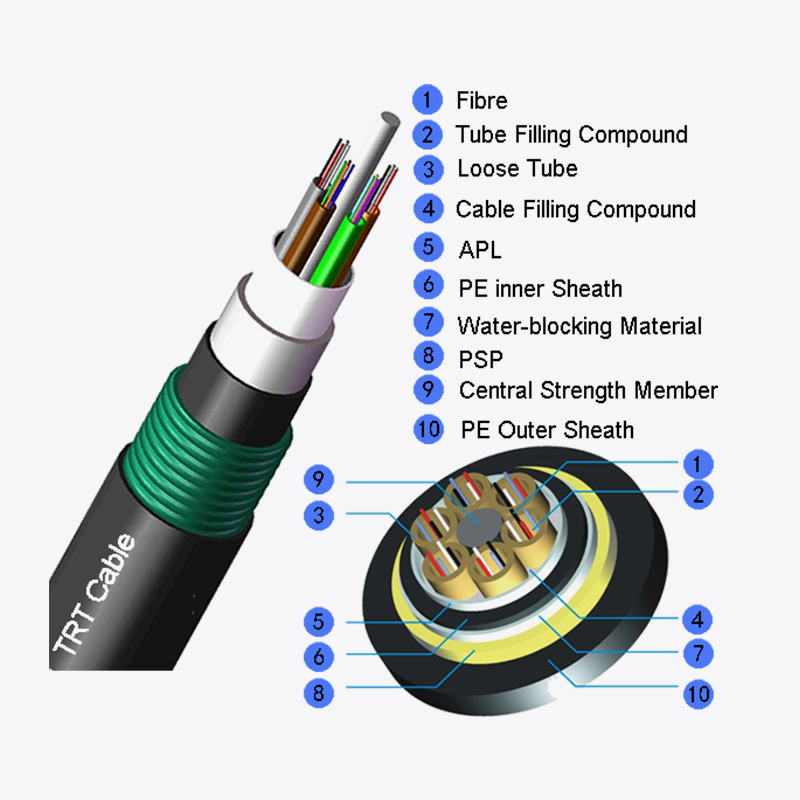
A 96 strand outdoor cable uses stranded loose tube construction in the overwhelming majority of cases. In this design, each fiber group sits loosely inside a buffer tube filled with gel or protected by dry water-blocking tape. These tubes are then stranded around a central strength member, which is usually FRP (fiber reinforced plastic) or steel wire. The system allows fibers to move slightly during bending, prevents direct mechanical pressure on the glass, and distributes pulling forces across the whole cable.
Stranded Loose Tube vs Central Tube
Central tube construction places all fibers in one large tube. It works well for 12F and 24F cables, but at 96 fibers the tube becomes large and stiff, which makes termination and bending harder. For 96 strand, stranded loose tube is the industry default.
Armoring and Water-Blocking Options
Different designations signal different levels of mechanical protection. For a 96 strand cable, the most common types in an outdoor environment are:
- GYTA: aluminum tape armor, used for duct installation.
- GYTS: steel tape armor, suitable for duct and light direct burial.
- GYTA53: double-jacket steel tape armor, for direct burial and rodent-prone areas.
- GYTY53: similar to GYTA53 with an additional strength layer.
- GYFTY: non-metallic, for areas with high electromagnetic interference.
Water blocking is either gel-filled or dry. Gel-filled tubes have decades of proven field performance but are messier to handle. Dry water-blocked tubes use swellable tapes and are preferred for aerial and indoor/outdoor applications. Both versions are acceptable if the cable meets the relevant IEC 60794 standard.
Key takeaway: For a 96 strand cable, stranded loose tube is the safest construction choice because it balances fiber protection, bend performance, and termination accessibility. The armor and water-blocking layers should be selected for the route, not based on fiber count alone.
Fiber Types and Specifications for 96 Strand Cabling
The strands in a 96F cable can be single-mode or multimode. For outdoor trunk, feeder, and campus backbone routes, the default is single-mode because distances usually exceed 500 m and the installed capacity must last for many years.
Single-Mode Options
G.652D is the most common fiber type in 96 strand outdoor cables. It offers low attenuation and stable performance across the 1310 nm and 1550 nm windows. G.657A1 is a bend-insensitive variant designed for tight-bend environments such as indoor risers, terminal blocks, or dense duct sections. G.655 non-zero dispersion-shifted fiber appears less often in 96F distribution cables, but it is specified in long-haul DWDM routes.
Multimode Options
Although uncommon for outdoor 96F feeders, multimode cables with OM3 or OM4 fibers are used in data center and building backbones. OM3 supports 10G up to 300 m, while OM4 extends 10G to 550 m. A 96F multimode cable is not typically a standard inventory item, so confirm availability with the factory before ordering.
When you write the specification, include the fiber type, attenuation coefficient, dispersion value, and jacket material. For a 96F single-mode outdoor cable, the most common specification is G.652D or G.657A1 with a PE outer sheath.
Typical Applications for 96 Strand Fiber Optic Cables
96F cables appear wherever a network needs a medium-to-large fiber bundle between two points. The main applications are:
- Campus and enterprise backbones: linking several buildings in a corporate park or university. Each building receives a 12F or 24F group, and spare fibers support future expansion.
- Metro and access network feeders: running along a street route to feed multiple distribution cabinets. The 96F feeder can be split into smaller 8F or 16F branches at closures.
- Data center interconnects: connecting two data halls, or linking a data center to the campus network. In this scenario, an indoor or indoor/outdoor 96F cable is used.
- FTTH feeder sections: carrying fiber from the optical line terminal to neighborhood distribution boxes. A 96F closure and distribution box allow flexible splitting into smaller drop-cable groups.
- Industrial and utility communication: substation networks, railway signaling, and smart-grid backbones. Armored 96F cables provide mechanical and rodent protection.
How to Choose a 96 Strand Fiber Optic Cable
Selecting the right cable is a balancing test between environment, capacity, and cost. Use these five questions to narrow the options:
- Is the cable indoor, outdoor, or both? Jacket material changes with the location. Outdoor routes require a UV-resistant PE jacket. Indoor risers need LSZH or PVC. The indoor vs outdoor fiber optic cable structural design comparison explains these material differences in detail.
- Will it run in duct, aerial, or direct burial? Direct burial requires armor. GYTA53 with steel tape and a double jacket is the standard choice. Aerial routes need high tensile strength and UV resistance.
- What is the conduit diameter and pulling distance? A stranded loose tube 96F cable is typically 15-18 mm in outer diameter, but check the factory spec. If the existing duct is small, the cable diameter matters more than the fiber count.
- Do you need bend-insensitive fiber? For routes with sharp bends or indoor transition points, G.657A1 fibers reduce the risk of bend loss.
- What accessories are required? A 96F cable must be terminated. You will need a splice closure at the splice points and a distribution box or cabinet at the far end.
For outdoor trunk and direct-burial routes, a stranded loose tube armored cable GYTA53 is a reliable choice. It delivers 96 strand capacity with steel tape armor and dual jackets that protect against rodents and soil moisture.
96 Strand Armored GYTA53 Loose Tube Cable for Outdoor Direct BurialThis armored cable provides 96 fiber strands with steel tape and dual jackets, offering protection against rodents and soil moisture, suitable for outdoor trunk and direct-burial routes.View Product →
At the far end of a feeder, a SMC 96 core fiber box is commonly used to split the incoming 96F bundle into smaller outgoing groups. This box works well in outdoor pole-mounted or wall-mounted installations.
 96 Core SMC Outdoor Fiber Optic Cabinet for Pole or Wall MountDesigned for splitting incoming 96F bundles, this SMC cabinet is suited for outdoor pole or wall mounting, with dimensions of 840*450*280mm for reliable distribution.View Product →
Before you finalize the count, read the full guide on how to choose the right fiber optic cable types to check how 96F compares to other counts in terms of diameter, cost, and splice labor.
Installation and Splicing 96 Strand Cables
Installing a 96F cable is more demanding than a 12F or 24F job. Two factors drive most field issues: bend radius and pulling tension.
Bend Radius
A stranded loose tube 96F cable typically has a minimum bend radius of 15-20 times the cable diameter during installation. With a 16 mm cable, that means 240-320 mm. During operation, the recommended bend radius is larger, around 20-25 times the diameter. Exceeding the bend radius can cause micro-bending and permanent insertion loss.
Pulling Tension
The maximum pulling force for a 96F cable is usually between 1000 and 2700 N, depending on the strength member. Steel-reinforced cables tolerate more pulling force than FRP-reinforced versions. Always use a pulling grip that distributes the load over the jacket and strength member, and never pull directly on the fiber bundle.
Splice Closures
Every 96F splice point needs a closure that holds at least 96 splice positions. A standard 96 core fiber optic splice closure provides multiple trays and can handle inline or branch splicing. If you expect to add a second 48F drop later, choose a closure that already supports 144F so you do not have to replace the enclosure.
 96 Core Fiber Optic Splice Closure with Waterproof SealingOffering 96 splice positions with multiple trays, this closure handles inline or branch splicing and features waterproof rubber strip sealing, suitable for outdoor installations.View Product →
Why TRTCABLE for 96 Strand Fiber Optic Cables
TRTCABLE manufactures 96 strand outdoor cables and the passive components that go with them. The company operates four production bases in China with 18,000 square meters of factory space, plus an overseas branch in Indonesia. Annual cable capacity reaches 300,000 core-km, and products are exported to 85 countries.
For a 96 strand cable project, you need more than the cable. You also need splice closures, distribution boxes, patch cords, and a supplier that can coordinate the whole package. TRTCABLE's product catalog covers the complete physical layer, from outdoor armored cables to indoor drop cables, FTTH boxes, PLC splitters, and quick connectors. The company holds ISO 9001 and ISO 14001 certification, and its vertical integration allows it to control quality across the production chain.
Working with a single manufacturer for cable and closures reduces compatibility risks and simplifies after-sales support. That matters when a 96F feeder is only one part of a larger network rollout.
Frequently Asked Questions
Q1: Is 96 strand the same as 96 core?
Yes. The terms strand, core, and fiber are used interchangeably for a 96-count cable. All refer to the 96 individual optical fibers inside the outer sheath.
Q2: How many fibers per tube does a 96 strand cable have?
The two most common layouts are 8 tubes with 12 fibers each and 12 tubes with 8 fibers each. Some manufacturers also offer 6x16 or 4x24 configurations for specific projects.
Q3: Does a 96 strand cable need a special splice closure?
It needs a closure with at least 96 splice positions. A standard 96 core splice closure with 4-6 trays is sufficient for most networks. If you plan to add strands later, use a larger closure.
Q4: Can a 96 strand cable be used in a data center?
Yes. Use an indoor or indoor/outdoor cable with an LSZH jacket and bend-insensitive G.657A1 fiber. A 96F cable is often used to connect data halls or to break out to multiple racks in a campus environment.
 Address:Zhong'an Road, Puzhuang Town, Suzhou City, Jiangsu Prov., China
 Phone:+86-189 1350 1815
 Tel:+86-512-66392923
 Fax:+86-512-66383830
 Email:[email protected]
 Wechat: xiaobin18913501815
 whatsapp: +86 18913501815

 0