
 English
 русский
 Español
 Português
 عربى


Outdoor Fiber Optic Enclosure Buying Guide: Types, IP Ratings & Sizing
The right outdoor fiber optic enclosure is a mechanical protection system, not a passive container. The difference between a closure that fails in three years and one that survives fifteen comes down to four procurement decisions: body material, IP rating, seal mechanism, and cable entry method. Get those right during specification and the network operation team will never see a degradation ticket related to enclosure failure.
Consider what happens when a contractor selects an IP65 polycarbonate closure for a manhole installation. The manhole floods twice a year. Water ingress reaches the splice tray within four years. Attenuation increases by 0.5 dB per splice point, which is enough to push a borderline optical link over the threshold. The enclosure itself did not break - the specification choice did.
Types of Outdoor Fiber Optic Enclosures
Outdoor enclosures fall into four functional categories, and each one solves a different problem on the network path. Understanding the field installation context is the first step toward a reliable purchase.
Fiber Optic Splice Closures
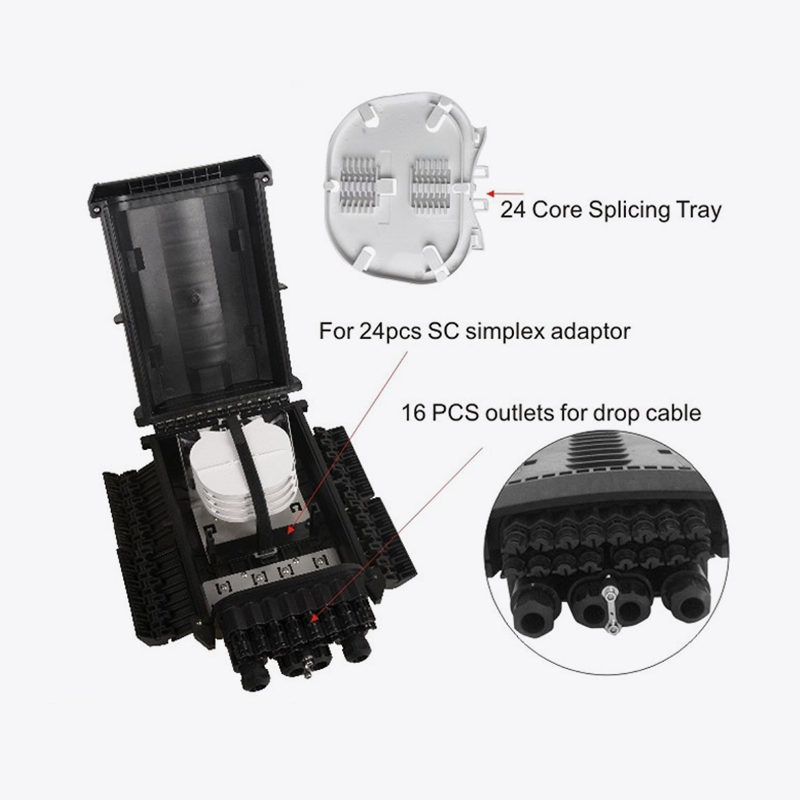
Splice closures protect the point where two cable segments are joined. They install in aerial, underground, and direct burial environments. Horizontal closures are preferred for aerial installations where cables enter and exit from opposite sides. Vertical closures are more common in manholes and handholes where space is constrained. A 288-core fiber optic splice closure from our production line handles high-fiber-count trunk lines while keeping a compact envelope for aerial or buried deployments.
96-Core Fiber Optic Splice Closure with 16 Drop Cable PortsThis mechanical-seal closure offers 4 inlet and 16 outlet ports, including an uncut port, and IP68 protection. It suits trunk line splicing and FTTH distribution in aerial or buried settings.View Product →
FTTH Distribution Boxes
Distribution boxes are the access point where a feeder cable splits into multiple drop cables. They mount on poles, walls, or pedestals near the customer side of the network. The T7200 and T9000 series boxes cover 8 to 96 cores, with PLC splitter slots integrated into several models. An SMC 96-core fiber box provides double-layer management for incoming feeder fibers and outgoing drop cables, and it accommodates both splice trays and PLC splitter modules in a single enclosure.
 SMC 96-Core Fiber Optic Distribution Box for Pole or Wall MountingMade of SMC, this large box provides ample space for fiber management and splitter modules, serving as a reliable cross-connect point for moderate-density distribution networks.View Product →
Outdoor Fiber Optic Cabinets
Cabinets are large enclosures used at street level or near central office locations. They serve as the cross-connect point between the feeder network and the distribution network, handling cable terminations, patching, and switching. SMC outdoor cabinets are the standard choice for telecom operators because of their corrosion resistance and thermal insulation. A 144-core SMC outdoor fiber optic cabinet is a wall or pole-mounted cabinet designed for network access points with moderate to high fiber requirements.
 144-Core SMC Outdoor Fiber Optic Cabinet for Network Access PointsThis corrosion-resistant SMC cabinet, sized 1050x550x310mm, supports up to 144 cores. It is suited for wall or pole mounting at outdoor cross-connect locations.View Product →
Fiber Optic Terminal Boxes
Terminal boxes are the last enclosure before the customer's optical network unit. They are small, typically 1 to 8 cores, and installed on the exterior wall of a building. The T8000 series terminal boxes use a compact, sealed design that protects the drop cable and the connector inside while minimizing the visual footprint on the facade.
Rule of thumb: splice closures for trunk line joins, distribution boxes for FTTH splits, cabinets for cross-connects, and terminal boxes for customer access points.
Material and IP Rating Considerations
The two most common body materials for outdoor enclosures are SMC (Sheet Molding Compound) and polycarbonate. SMC is fiberglass-reinforced, providing superior mechanical strength, UV resistance, and tolerance to extreme temperatures. Polycarbonate is lighter and more cost-effective but tends to embrittle after years of direct sunlight exposure. For permanent installations, SMC is the safer long-term investment.
IP rating is the first specification to verify. IP65 protects against water jets, IP67 against temporary immersion, and IP68 against continuous submersion. Aerial installations normally require IP65. Underground and manhole installations require IP67 or IP68. If a supplier does not publish an IP rating for an outdoor enclosure, do not specify it.
Gaskets and seals are where many enclosures fail in practice. EPDM rubber gaskets retain elasticity across a broader temperature range than silicone gaskets, which harden in cold environments. The closure lid should use a stainless steel clamp or bolt mechanism that resists corrosion, not a plastic latch that cracks under UV exposure. Before finalizing a purchase, ask about the gasket material and the clamping hardware.
Learn more about IP rating requirements for waterproof fiber optic enclosures to match protection levels with your installation context.
Fiber Capacity and Configuration Planning
Overcapacity is a common purchasing mistake. A 288-core closure in a location where you only need 24 cores increases material cost and installation complexity. But undercapacity creates expensive rework. The planning formula is simple: current splice count, plus expected growth over five years, plus a 10 to 15 percent expansion margin. Then choose the nearest standard size above that number.
| Application | Fiber Count | Typical Enclosure Type |
|---|---|---|
| FTTH access point | 8-48 | Distribution box |
| Feeder splicing | 48-144 | Splice closure |
| Long-distance trunk | 144-288 | Dome splice closure |
| Street cross-connect | 144-576 | Outdoor cabinet |
Compatibility with existing network components also matters. Check the splice tray arrangement, the cable entry diameter, and whether the closure accepts the cable diameter range you plan to use. A closure designed for 8 to 14 mm cables cannot accommodate a 20 mm armored cable without an exchange kit. The relationship between enclosure selection and outdoor cable design is covered in indoor vs outdoor fiber optic cable structural differences, which explains why cable reinforcements affect enclosure entry requirements.
How to Choose the Right Outdoor Fiber Optic Enclosure
Start with a structured assessment before opening a product catalog. This sequence prevents the most common selection errors.
- Define the installation environment. Aerial, duct, direct burial, or manhole - each one has a different IP rating and mechanical requirement.
- Count the fibers. Count cables entering and leaving, not just the splice count. Include splitter fibers in distribution boxes.
- Determine the cable entry method. Heat-shrink, mechanical sealing, or gel seal - each has different installation time and re-entry characteristics.
- Check closure dimensions. The enclosure must fit in the available space. A manhole with 400 mm clearance cannot accommodate a 500 mm closure.
- Verify access and re-entry capability. Some closures are designed for permanent installation with limited re-entry. Others allow frequent re-entry during construction phases.
Procurement perspective: If you are buying for a contractor, consider the installation speed of the sealing system. Heat-shrink creates a permanent seal but requires a heat gun and adds 8 to 10 minutes per cable entry. Mechanical seals are faster but need periodic torque checks. For a rollout with hundreds of closures, that time difference translates into a real labor cost.
Frequently Asked Questions About Outdoor Fiber Optic Enclosures
Q1: What is the difference between a fiber optic enclosure and a splice closure?
The two terms are often used interchangeably, but a splice closure specifically protects spliced fiber joints, while an enclosure is a broader term that includes distribution boxes, terminals, and cabinets. When buyers search for an outdoor fiber optic enclosure, they usually mean a splice closure or a distribution box.
Q2: How long do outdoor fiber optic enclosures last?
With the correct IP rating and UV-resistant material, an enclosure should remain functional for 15 to 20 years. Gaskets are the first component to degrade, so selecting a closure with replaceable gaskets extends service life significantly.
Q3: Can I use an indoor enclosure outdoors?
No. Indoor enclosures are not designed for UV exposure, moisture ingress, or temperature cycling. Using one outdoors reduces its service life to under three years and creates a high risk of water ingress.
Q4: How do I determine the IP rating I need?
Determine whether the installation location is exposed to direct rain (IP65), temporary flooding (IP67), or continuous water submersion (IP68). Aerial installations typically require IP65, while manhole and direct-burial installations require IP67 or higher.
 Address:Zhong'an Road, Puzhuang Town, Suzhou City, Jiangsu Prov., China
 Phone:+86-189 1350 1815
 Tel:+86-512-66392923
 Fax:+86-512-66383830
 Email:[email protected]
 Wechat: xiaobin18913501815
 whatsapp: +86 18913501815

 0