
 English
 русский
 Español
 Português
 عربى
عربى


What is Drop Cable and How is it Used in Networking?
What Is a Drop Cable?
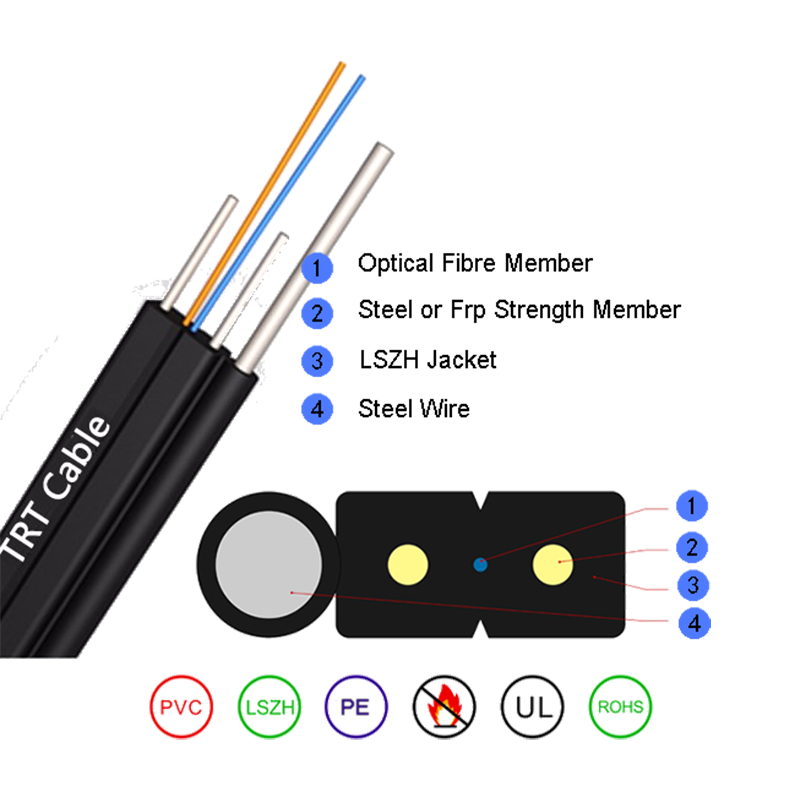
A drop cable is a short-run fiber optic or coaxial cable that connects a distribution point — such as a street-side distribution terminal or a network access point — directly to an end-user's premises. In plain terms, it is the last segment of a network's delivery chain, bridging the gap between the backbone infrastructure and the subscriber's home or business. Drop cables are foundational to Fiber-to-the-Home (FTTH), Fiber-to-the-Building (FTTB), and hybrid fiber-coax (HFC) deployments worldwide.
Typical drop cable runs range from 30 meters to 200 meters, though longer spans are possible with appropriate engineering. Their compact design, weather resistance, and ease of installation make them the go-to solution for the final connection in broadband and telecommunications networks.
Key Components and Structure
Understanding what a drop cable is made of helps clarify why it performs so reliably in outdoor and indoor environments.
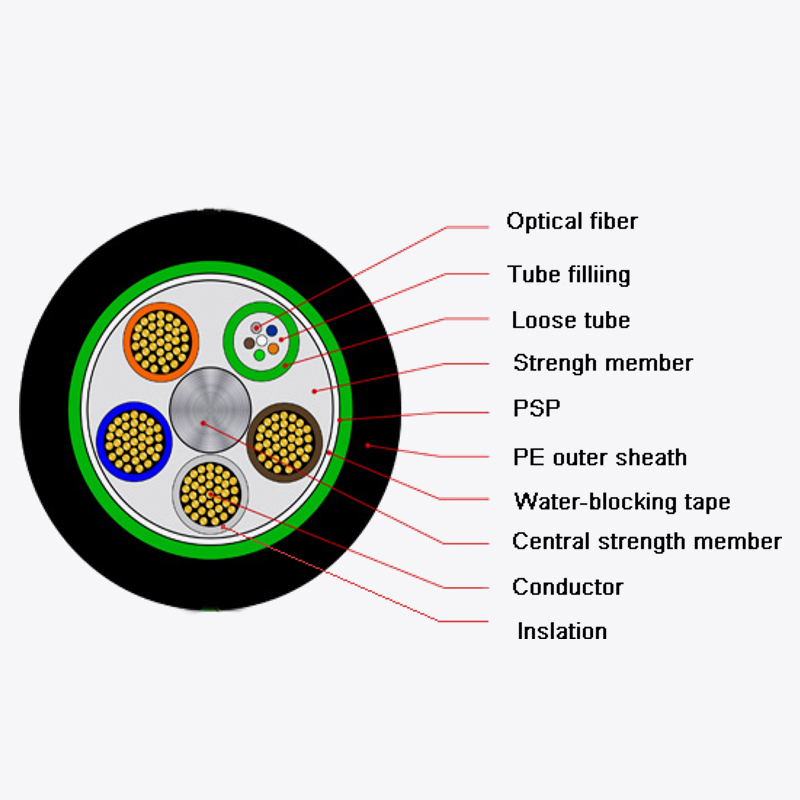
- Optical fibers or coaxial core: The signal-carrying element. Single-mode fibers (SMF, commonly G.657A1/A2) are standard for FTTH drops due to their bend-insensitive design.
- Strength members: Fiberglass rods (FRP) or steel wires resist tensile stress during installation and throughout the cable's service life.
- Water-blocking elements: Gel-filled layers or dry water-blocking tapes protect the fiber core from moisture ingress.
- Outer jacket: HDPE (High-Density Polyethylene) or LSZH (Low Smoke Zero Halogen) sheathing provides UV resistance, mechanical protection, and environmental durability.
- Messenger wire (self-supporting designs): An integrated steel or dielectric messenger allows aerial installation without a separate support strand.
Common Types of Drop Cable
Drop cables are not one-size-fits-all. Several designs address specific deployment needs:
| Type | Structure | Typical Use Case |
| Flat Drop Cable (Fig-8) | Flat jacket with integrated messenger | Aerial last-mile spans, pole-to-building |
| Round Drop Cable | Circular cross-section, FRP strength members | Direct burial, duct installation |
| Self-Supporting Drop Cable | Figure-8 with steel or dielectric wire | Aerial runs without extra messenger hardware |
| Indoor/Outdoor Drop Cable | Dual jacket (LSZH inner + HDPE outer) | Entry points transitioning from outdoor to indoor |
| Armored Drop Cable | Corrugated steel or aluminum armor layer | Rodent-prone areas, direct burial in harsh soils |
| Micro Drop Cable | Ultra-slim diameter (≤3mm) | Wall-mounted indoor routing, multi-dwelling units |
How Drop Cable Is Used in Networking
Drop cables serve as the critical link in the access network. Here is how they fit into a real-world fiber deployment:
- Signal originates at the Central Office (CO) or Headend — high-capacity trunk and feeder cables carry data from the CO to distribution hubs in neighborhoods.
- Distribution terminals or splitter cabinets divide the optical signal and route it to individual service areas.
- Drop cable bridges the final gap — running aerially on poles, underground through conduit, or along building facades — from the terminal to the subscriber's ONT (Optical Network Terminal) or modem.
- The ONT converts optical signals to electrical Ethernet signals that feed the home router and connected devices.
In GPON and XGS-PON networks — the two dominant FTTH standards — drop cables typically carry 1–4 fibers per subscriber, with G.657A2 bend-insensitive fiber allowing tight bends as small as 7.5 mm radius without measurable signal loss.
Installation Methods
Aerial Installation
Aerial drop cables are strung between utility poles using a figure-8 or self-supporting design. Typical span lengths are 40–80 meters per pole section. Installation hardware includes lashing wire, cable clamps, and dead-end grips. This method is fast and cost-effective in areas with existing pole infrastructure.
Underground / Direct Burial
Round or armored drop cables are plowed or trenched into the ground at a typical depth of 30–60 cm. Rodent-resistant armored variants are recommended in agricultural or suburban environments where cable damage from digging animals is a risk.
Indoor Entry and Routing
When transitioning from outdoor to indoor, the cable passes through a weatherproof entry fitting. Indoor segments often use micro drop cables or LSZH-jacketed cables for routing along baseboards or through conduit within the building. For multi-dwelling units (MDUs), cables may run vertically through riser conduits to each floor.
Blown Fiber (Microduct)
In microduct-based deployments, ultra-slim fiber units are pneumatically blown through pre-installed micro conduits. This approach enables future-proofing: additional fibers can be added without re-trenching, significantly reducing long-term upgrade costs.
Technical Specifications to Consider
When selecting a drop cable for a network project, these parameters matter most:
- Fiber count: 1F, 2F, 4F configurations cover most residential deployments; 8F or higher for MDUs or future-ready builds.
- Fiber type: G.657A1 (15 mm bend radius) or G.657A2 (7.5 mm bend radius) — A2 is preferred for tight routing indoors.
- Operating temperature: Standard range is -40°C to +70°C for outdoor-rated cables.
- Tensile strength: Typically 300–1,000 N depending on messenger wire and construction; higher values are essential for long aerial spans.
- Attenuation: ≤0.4 dB/km at 1310 nm and ≤0.3 dB/km at 1550 nm (standard single-mode).
- Jacket material: HDPE for outdoor durability; LSZH for indoor fire safety compliance.
- Compliance standards: ITU-T G.657, IEC 60794-2, RoHS, REACH as applicable.
Advantages of Modern Drop Cables
Advances in materials and manufacturing have significantly improved drop cable performance over the past decade:
- Bend-insensitive fiber reduces installation errors and signal loss during tight routing around corners and through conduit bends.
- Lightweight construction (as low as 35 g/m for micro designs) reduces load on poles and simplifies handling.
- Pre-connectorized options allow field technicians to complete connections without fusion splicing, cutting installation time from hours to minutes.
- All-dielectric designs eliminate lightning strike risks in aerial deployments, improving safety and reducing maintenance.
- Extended service life of 25–30 years with proper installation, lowering the total cost of ownership for network operators.
Drop Cable vs. Distribution Cable vs. Feeder Cable
These three cable types are often confused. Here is a clear comparison:
| Cable Type | Network Position | Fiber Count | Typical Length |
| Feeder Cable | CO to distribution hub | 48–432 fibers | 1–10 km |
| Distribution Cable | Hub to neighborhood terminal | 12–144 fibers | 0.5–3 km |
| Drop Cable | Terminal to subscriber | 1–8 fibers | 30–200 m |
While feeder and distribution cables prioritize high fiber density and long-distance performance, drop cables are engineered for flexibility, ease of installation, and environmental resilience over short final-mile distances.
Frequently Asked Questions
Q1: What is the maximum length for a drop cable?
In most FTTH deployments, drop cables are kept under 200 meters. However, with low-attenuation G.657 fiber and proper power budget planning, runs up to 500 meters are achievable without signal degradation in standard GPON systems.
Q2: Can drop cable be used indoors?
Yes. Indoor/outdoor and micro drop cables with LSZH jackets are designed for both environments. They comply with indoor fire safety codes while withstanding outdoor UV exposure and moisture.
Q3: What fiber type does drop cable use?
Most modern drop cables use ITU-T G.657A1 or G.657A2 bend-insensitive single-mode fiber. G.657A2 is preferred for tight indoor routing due to its smaller minimum bend radius of 7.5 mm.
Q4: Is armored drop cable necessary?
Armored drop cable is recommended for direct burial in areas with rodent activity, rocky soils, or high mechanical stress risk. For standard aerial or duct installations, non-armored designs are sufficient.
Q5: What is a pre-connectorized drop cable?
A pre-connectorized drop cable comes with factory-installed connectors (typically SC/APC or LC/APC) on one or both ends. This eliminates the need for field splicing, reducing installation time and improving connection consistency.
Q6: How is a drop cable attached to a building?
Aerial drop cables are anchored to the building facade using a dead-end hook and cable clamp, then routed to the entry point through a weatherproof cable entry gland or conduit fitting to prevent water ingress.
 Address:Zhong'an Road, Puzhuang Town, Suzhou City, Jiangsu Prov., China
 Phone:+86-189 1350 1815
 Tel:+86-512-66392923
 Fax:+86-512-66383830
 Email:[email protected]
 Wechat: xiaobin18913501815
 whatsapp: +86 18913501815

 0
0