
 English
 русский
 Español
 Português
 عربى
عربى


Why Drop Cable is the Backbone of Reliable FTTH Networks
The global push for gigabit connectivity has transformed modern communication infrastructures, positioning Fiber to the Home (FTTH) as the ultimate standard for broadband delivery. Within this architecture, the final link between the distribution network and the subscriber premises represents both the most critical and the most vulnerable segment of the optical path. This specialized segment relies entirely on the deployment of a resilient drop cable to bridge the physical gap from the street to the property. As optical signals transition from long-haul transport infrastructures to local distribution lines, preserving signal integrity across the last mile requires advanced cable engineering that can withstand mechanical stress, environmental fluctuations, and complex installation routing.
Often overlooked in comparison to high-capacity feeder cables, the residential fiber optic cable serves as the true backbone of network reliability. It functions as the primary physical medium determining whether a subscriber experiences consistent, low-latency gigabit performance or frequent service disruptions. Understanding the mechanical anatomy, deployment methodologies, and strategic termination points of an FTTH drop cable reveals why this component is central to modern telecommunications engineering. This analysis examines the technical dimensions that make these cables indispensable for delivering reliable, high-speed home internet access.
The Mechanical Anatomy of Residential Fiber Optic Cables
A residential fiber optic cable must balance two conflicting requirements: structural durability and high flexibility. Unlike heavy-duty underground or aerial feeder cables that follow straight, unobstructed pathways, a fiber optic cable in house networks must navigate sharp corners, tight building entry points, and varied external environments. To achieve this versatility, manufacturers utilize distinct structural profiles engineered for specific mechanical demands.
Classification by Design: Bow-Type vs. Round Configurations
The standard ftth drop cable is generally manufactured in two primary configurations, each tailored to distinct deployment scenarios:
- Bow-Type Drop Cable: Characterized by a flat, hourglass cross-section, this design features an optical fiber positioned exactly in the center, flanked by two parallel strength members. The flat profile provides excellent lateral crush resistance and predictable bending characteristics along a single axis, making it highly effective for indoor conduit routing and direct stapling along architectural borders.
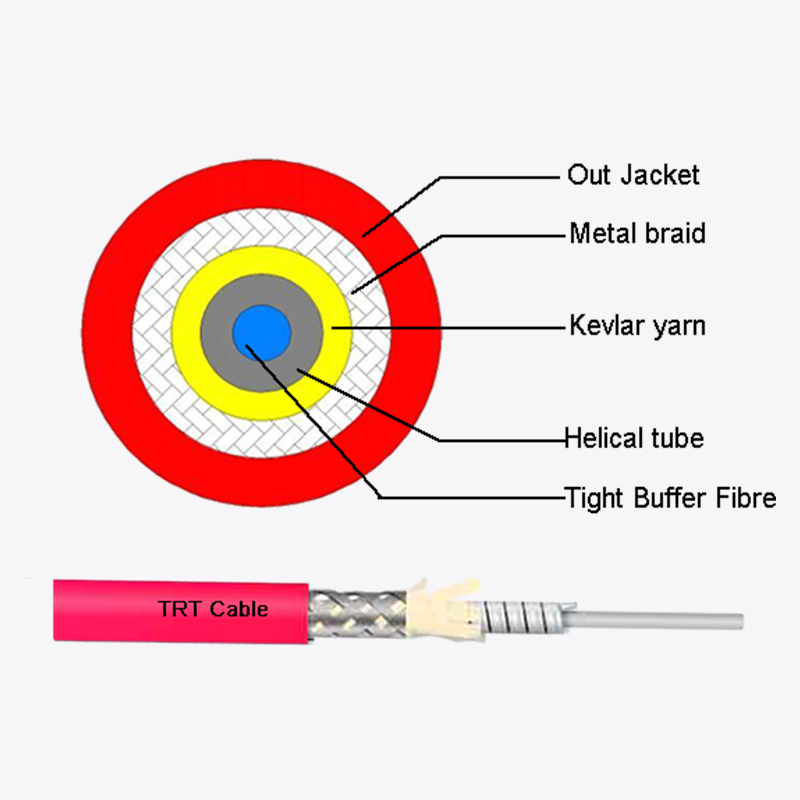
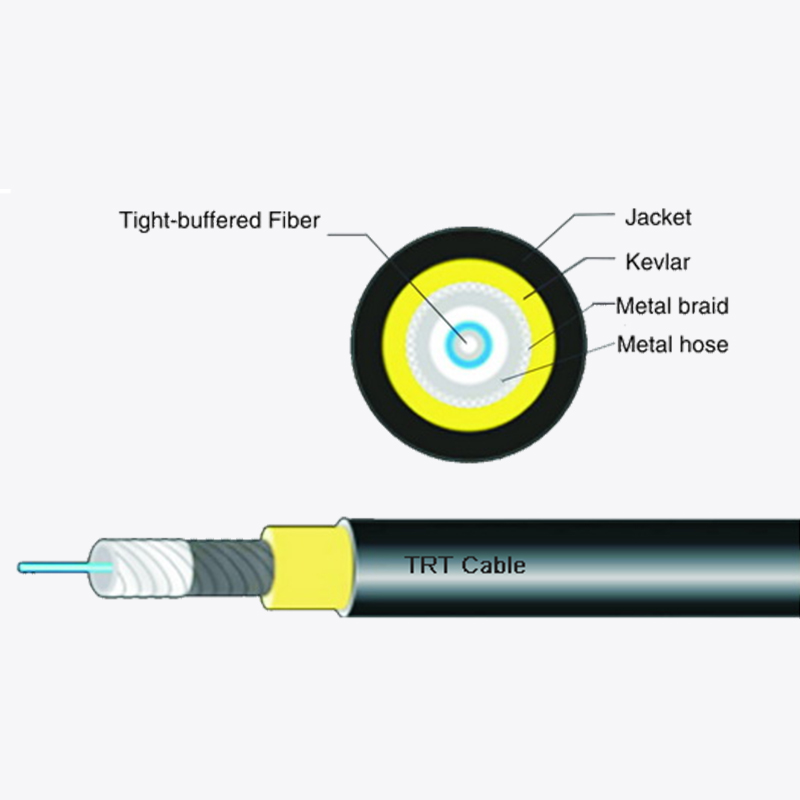
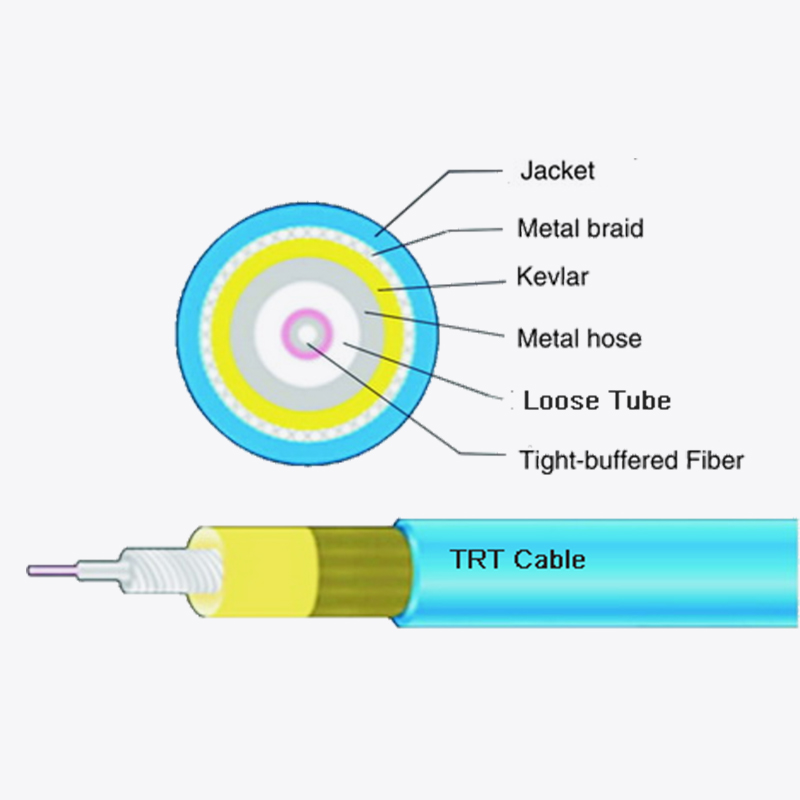
- Round Drop Cable: Utilizing a traditional cylindrical profile, round designs typically incorporate loose tubes or tight-buffered fibers surrounded by aramid yarns and an outer jacket. Round cables offer omnidirectional flexibility, allowing them to bend equally well in all directions, which is advantageous for complex outdoor aerial pathways containing multi-directional wind vectors.
Optimized for directional bending, high crush resistance, and low-profile residential routing inside buildings and standard conduits.
Engineered for omnidirectional flexibility, complex aerial pathways, and high-tensile resistance against environmental wind loads.
The Role of Strength Members and Outer Jackets
The longevity of a home fiber optic cable depends on its internal strength members, which absorb tensile loads during installation and long-term operation. These members prevent physical strain from transferring to the delicate glass core, avoiding signal degradation. Steel wire strength members provide exceptional tensile strength for outdoor applications, while Fiber Reinforced Plastic (FRP) elements offer non-conductive, lightweight alternatives ideal for all-dielectric deployments. Protecting these internal components is an outer jacket made from Low Smoke Zero Halogen (LSZH) compounds for indoor safety, or UV-resistant polyethylene (PE) formulations engineered to withstand decades of solar radiation and extreme thermal cycling without cracking.
Aerial vs. Underground Deployment Methodologies
Deploying a fiber optic cable for home internet requires choosing between aerial and underground routing. Each methodology presents unique mechanical challenges and demands specific structural characteristics from the cable jacket and core elements.
Aerial Installation and Mechanical Tension Management
Aerial installations offer rapid deployment profiles but expose the cable to severe environmental forces. To withstand wind loads, ice accumulation, and structural sagging, networks utilize a self-supporting drop cable. This variant features an integrated steel or heavy FRP messenger wire configured in a figure-eight cross-section. The messenger wire absorbs the structural tension across spans, preventing the optical core from exceeding its maximum tensile limitation. Span length calculations, structural sag ratios, and environmental loading factors must be strictly managed during engineering design to ensure the fiber remains unstressed over decades of continuous exposure.
Underground Installation and Protection Mechanisms
Underground pathways eliminate aerial environmental risks but expose the infrastructure to high compression loads, water ingress, and potential rodent damage. Cables installed via direct burial or pulled through protective PVC conduits require enhanced physical protection. These configurations often feature thick, high-density polyethylene (HDPE) jackets, water-blocking gel matrices, or swellable tape layers that expand upon contact with moisture to seal structural breaches. For direct burial scenarios, metallic or hard dielectric armoring layers are integrated to disperse point-load compression forces and deter boring pests.
| Parameter | Aerial Deployment | Underground Deployment |
|---|---|---|
| Primary Stressors | Wind load, ice accumulation, thermal expansion | Crush pressure, moisture ingress, rodent attacks |
| Cable Type | Figure-8 self-supporting, high-tensile strength | Armored or heavy-duty PE jacketed configurations |
| Installation Speed | Rapid deployment utilizing existing utility poles | Slower, requiring trenching or conduit pulling |
| Long-term Lifecycle | Exposed to environmental degradation and UV wear | Protected from atmosphere, vulnerable to ground shifts |
The Crucial Role of the Demarcation Point
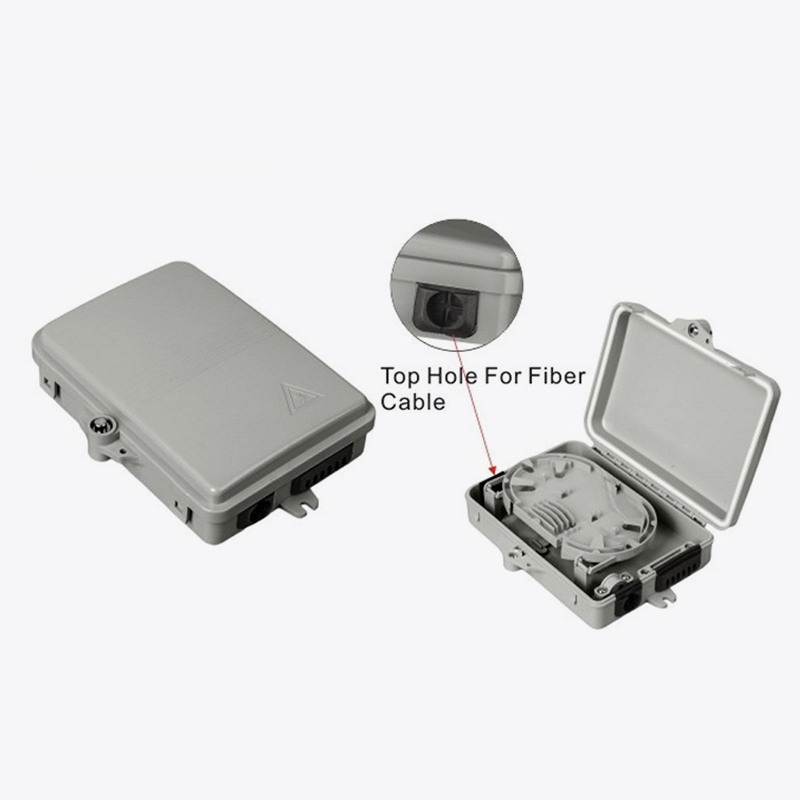
The point where an external distribution cable transitions into an indoor network is a critical junction in FTTH network design. This boundary safeguards signal continuity and establishes clear technical management limits. At this physical intersection sits the Fiber Optic Box-FTTH, serving as the secure enclosure where the external infrastructure terminates and transitions to internal distribution lines.
This termination enclosure performs several critical functions:
- Environmental Isolation: Protects delicate fusion splices or mechanical connectors from dust, moisture, and ambient temperature shifts.
- Bend Radius Control: Features internal routing mandrels that enforce minimum bend radii, preventing macrobending attenuation.
- Strain Relief Management: Clamps the external cable strength members to anchor mechanical tension outside the connection core.
- Network Troubleshooting Limits: Provides a clear demarcation point between service provider distribution infrastructure and subscriber building wiring.
Inside this enclosure, the incoming external cable is typically spliced or interconnected to high-flexibility indoor patch cords. By separating these sections, the network ensures that any mechanical strain applied to internal wiring remains isolated from the external drop infrastructure, preserving long-term signal stability across the optical link.
Optical Performance and Bend Insensitivity
The performance of a modern network is directly tied to the optical properties of its fiber core under physical distortion. Traditional single-mode fibers suffer from macrobending loss when bent around tight radii, causing light to leak from the core into the cladding layer. Because residential installations require navigating sharp architectural transitions, standard single-mode fibers are generally unsuited for last-mile deployments.
To overcome this limitation, current residential installations rely on bend-insensitive single-mode fibers, structurally standardized under the ITU-T G.657 recommendation. These fibers incorporate an optical trench profile—a lower refractive index ring surrounding the core that reflects escaping light back into the fiber path. This design allows for significantly tighter bend radii without generating measurable signal attenuation.
| Fiber Standard | Minimum Bend Radius | Typical Application Environment |
|---|---|---|
| ITU-T G.652.D | 30 mm | Long-haul transport and wide area distribution networks |
| ITU-T G.657.A1 | 10 mm | Standard residential drop links and outdoor conduits |
| ITU-T G.657.A2 | 7.5 mm | Complex indoor routing and compact corner turns |
| ITU-T G.657.B3 | 5 mm | Ultra-compact termination boxes and tight micro-conduits |
Implementing G.657.A2 or G.657.B3 fibers within a flat bow-type drop cable enables technicians to route lines around doorframes, baseboards, and tight corners with minimal signal loss. This design ensures consistent transmission parameters at higher optical wavelengths, such as 1490 nm and 1550 nm, which are highly sensitive to bending stress and commonly used in passive optical networks (PON).
Future-Proofing Residential BroadBand Links
As consumer demand shifts toward symmetrical multi-gigabit connections driven by high-capacity data applications, the physical medium must support higher bandwidth tiers without requiring structural replacements. Upgrading network electronics like optical line terminals (OLT) and optical network terminals (ONT) is simple, but replacing physical cabling inside building walls or underground conduits is labor-intensive and costly. Deploying premium single-mode drop infrastructures ensures the physical layer remains compatible with next-generation optical transmission standards.
Modern home fiber networks are designed to support several evolutions in optical technology:
- GPON to XGS-PON Migration: Moving from standard gigabit networks to 10-Gigabit symmetrical links requires managing tighter optical power budgets, making low-attenuation drop paths critical.
- WDM Integration: Multi-wavelength systems rely on broad optical spectrum availability, which demands stable physical mediums free from moisture-induced attenuation or structural microbends.
- Higher Speed Protocols: Emerging 25G and 50G PON architectures use advanced modulation formats that are highly sensitive to signal reflection and polarization mode dispersion.
Investing in durable outer jacketing materials, optimized strength members, and advanced bend-insensitive fiber cores protects the physical infrastructure from premature material degradation. This engineering approach ensures that the installed link remains fully operational across multiple equipment lifecycles, protecting long-term capital investments.
Frequently Asked Questions
Q1: Why is a flat bow-type drop cable preferred for indoor residential installations?
The flat bow-type configuration provides excellent directional crushing resistance and predictable bending performance along its thin axis. This structural behavior allows technicians to neatly route, staple, and secure cables along baseboards, building corners, and narrow interior conduits without twisting the internal optical fiber or causing signal loss.
Q2: How does a self-supporting drop cable protect the optical core during aerial installation?
A self-supporting configuration incorporates a dedicated steel or high-tensile Fiber Reinforced Plastic (FRP) messenger wire running parallel to the fiber core within a integrated figure-eight jacket. This messenger wire bears the environmental stress from wind, ice weight, and physical span tension, ensuring the delicate optical core remains unstressed.
Q3: Can an outdoor rated drop cable be directly routed deep into a subscriber house?
Outdoor cables with heavy polyethylene (PE) jackets present fire safety hazards due to toxic smoke generation and are restricted by building codes for deep indoor routing. At the demarcation point, the line should transition inside a dedicated termination box to a fire-retardant Low Smoke Zero Halogen (LSZH) rated cable, or use a dual-rated cable approved for both indoor and outdoor environments.
Q4: What is the technical difference between G.652.D and G.657.A2 optical fibers?
G.652.D is the standard single-mode fiber optimized for long spans, requiring a minimum bend radius of 30 mm to prevent macrobending losses. G.657.A2 is an advanced bend-insensitive fiber engineered with a light-reflecting optical trench structure, allowing a tight 7.5 mm bend radius without causing measurable signal degradation during residential installation.
Q5: How does water-blocking technology within a drop cable prevent signal failure?
Underground and outdoor cables are exposed to moisture that can seep into microscopic surface cracks on the glass core, causing structural degradation and signal loss over time. Water-blocking gel compounds or super-absorbent tapes expand when exposed to moisture, sealing the breach and keeping water isolated away from the optical fiber core.
 Address:Zhong'an Road, Puzhuang Town, Suzhou City, Jiangsu Prov., China
 Phone:+86-189 1350 1815
 Tel:+86-512-66392923
 Fax:+86-512-66383830
 Email:[email protected]
 Wechat: xiaobin18913501815
 whatsapp: +86 18913501815

 0
0