
 English
 русский
 Español
 Português
 عربى
عربى


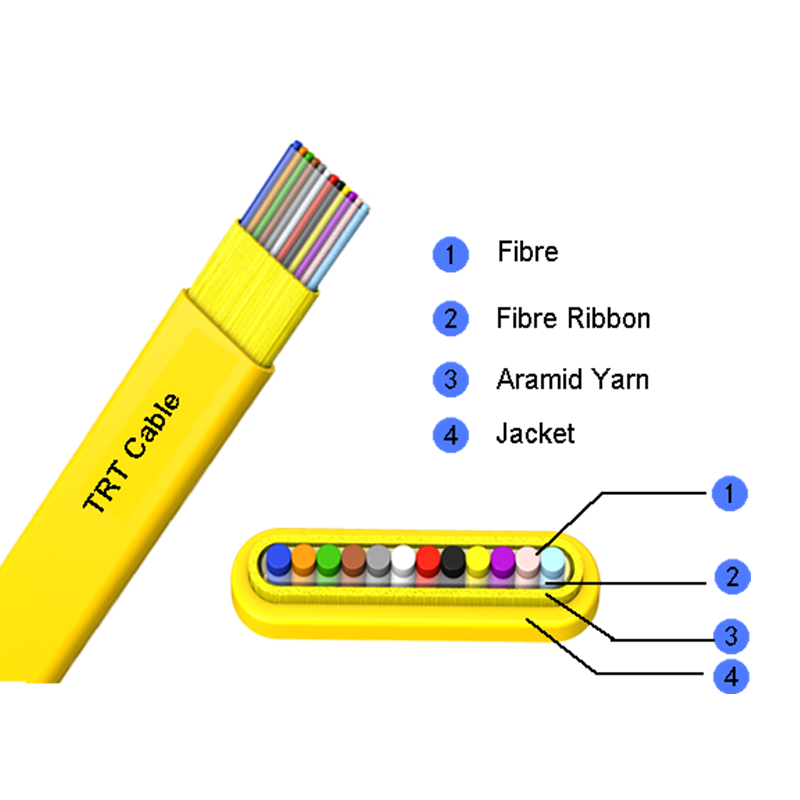
What is a flat fiber ribbon cable and why is it used for high-density networks?
Introduction to Flat Fibre Ribbon Cables
Flat fibre ribbon cables have become a vital component in high-density networks due to their ability to efficiently transmit large amounts of data over long distances. These cables are designed to maximize space and minimize interference, making them ideal for modern communication systems.
The structure of flat fibre ribbon cables consists of multiple fibres arranged in a flat, parallel configuration. This allows them to support high-speed data transmission while maintaining a compact form factor.
What Makes Flat Fibre Ribbon Cables Ideal for High-Density Networks?
Flat fibre ribbon cables are particularly suited for high-density networks because of their compact design and high fibre count. These cables can accommodate up to 24 or more fibres in a single flat structure, enabling the transmission of multiple data streams simultaneously without the need for excessive cabling.
Additionally, the flat configuration minimizes the space required for installation, which is crucial in environments where space is limited, such as data centres and server rooms. The ribbon design also allows for easier installation and maintenance, as multiple fibres can be accessed and terminated at once.
Key Advantages of Flat Fibre Ribbon Cables
High Bandwidth
One of the primary advantages of flat fibre ribbon cables is their ability to handle high-bandwidth applications. The high fibre count within the cable ensures that data can be transmitted at faster speeds, supporting the increasing demand for high-speed internet and large-scale data operations.
Space Efficiency
As mentioned earlier, the compact design of flat fibre ribbon cables allows them to fit into tight spaces without compromising performance. This is particularly important in environments such as high-density networks where space is often at a premium.
Cost-Effective
Flat fibre ribbon cables can reduce installation costs by allowing for more efficient use of space and fewer cables overall. This is especially beneficial for large-scale installations, where minimizing the number of cables used can lead to significant cost savings.
Applications of Flat Fibre Ribbon Cables
Flat fibre ribbon cables are used in various applications where high-density fibre optic connections are required. These include:
- Data centres and server rooms
- Telecommunications infrastructure
- High-speed broadband networks
- Large-scale enterprise networks
- Fibre-to-the-home (FTTH) installations
Why Choose Flat Fibre Ribbon Cables for Your Network?
Choosing the right cable for a high-density network is critical to ensure optimal performance. Flat fibre ribbon cables offer the following benefits:
- Durability: These cables are built to withstand harsh environments, making them a reliable choice for both indoor and outdoor installations.
- Scalability: With the ability to support many fibres in a single ribbon, these cables allow for easy scalability as network demands grow.
- Easy Maintenance: The flat design makes it easier to trace and troubleshoot cables in complex systems, reducing downtime.
If you're looking for high-performance and space-efficient network solutions, flat fibre ribbon cables are an excellent choice. For more information, visit our product page: Flat Fibre Ribbon Cable.
FAQs
Q1: What is the difference between flat fibre ribbon cables and traditional round fibre cables?
Flat fibre ribbon cables have multiple fibres arranged in a flat configuration, which allows for more efficient use of space. In contrast, traditional round fibre cables typically carry fewer fibres and require more space, making flat cables a better choice for high-density installations.
Q2: How many fibres can a flat fibre ribbon cable support?
Flat fibre ribbon cables can support up to 24 fibres or more, depending on the specific design and manufacturer. This high fibre count makes them ideal for environments where high data transmission is necessary.
Q3: Are flat fibre ribbon cables compatible with existing fibre optic infrastructure?
Yes, flat fibre ribbon cables are designed to be compatible with standard fibre optic connectors and can easily integrate into existing networks. However, proper termination and splicing techniques are required for optimal performance.
Q4: Can flat fibre ribbon cables be used for outdoor installations?
Yes, flat fibre ribbon cables are available in both indoor and outdoor variants. Outdoor versions are designed with additional protective coatings to withstand environmental factors such as moisture, UV rays, and extreme temperatures.
 Address:Zhong'an Road, Puzhuang Town, Suzhou City, Jiangsu Prov., China
 Phone:+86-189 1350 1815
 Tel:+86-512-66392923
 Fax:+86-512-66383830
 Email:[email protected]
 Wechat: xiaobin18913501815
 whatsapp: +86 18913501815

 0
0