
 English
 русский
 Español
 Português
 عربى
عربى


What Are the Different Types of Fiber Optic Cable and How Do You Choose the Right One?
The Two Core Fiber Types: Single-Mode vs. Multimode
Before diving into jacket styles and installation environments, every fiber optic decision starts with one fundamental question: single-mode or multimode? These two fiber categories differ at the glass level and determine transmission distance, bandwidth ceiling, and overall system cost.
- Cladding diameter: 125 µm
- Typical reach: 10 km to 100+ km
- Wavelengths: 1310 nm and 1550 nm
- Transceivers: laser-based, higher cost
- Use: telecom backbone, long-haul WAN
- Cladding diameter: 125 µm
- Typical reach: 300 m to 2,000 m
- Wavelengths: 850 nm and 1300 nm
- Transceivers: VCSEL-based, lower cost
- Use: data centers, enterprise LAN, SAN
Multimode Fiber Grades: OM1 Through OM5
The TIA-568 standard classifies multimode fiber opWhat Are the Different Types of Fiber Optic Cable and How Do You Choose the Right One?tic cable into five optical multimode (OM) grades. Each successive grade improves bandwidth and supports higher data rates over longer distances.
OM5 introduces short-wavelength division multiplexing (SWDM), allowing multiple wavelengths on one fiber strand. This paves the way for 400G and even 1T applications over existing OM5 infrastructure by multiplying channels without replacing cable.
Installation Environment: Indoor, Outdoor, and Direct-Burial
Beyond the fiber glass itself, the outer jacket and internal structure must match the physical environment. Using an outdoor cable indoors creates a fire hazard; using an indoor cable outdoors causes premature jacket degradation. The four primary environment categories are outlined below.
Combines gel-filled loose tubes, corrugated steel armor, and a thick polyethylene outer jacket to withstand ground moisture, frost heave, and soil pressure for decades. Typical burial depth: 60–90 cm below grade.
Carries both a UV-resistant outer jacket and a flame-retardant inner layer meeting plenum or riser ratings. Eliminates the splice box at the building entrance, reducing insertion loss and long-term maintenance points.
Fiber Optic Cable Size Chart
Physical dimensions matter during conduit fill calculations, tray management, and bend-radius planning. The table below provides a representative fiber optic cable size chart covering common fiber counts in a standard single-jacket round cable design.
| Fiber Count | Approx. OD (mm) | Min. Bend Radius (mm) | Weight (kg/km) | Typical Application |
|---|---|---|---|---|
| 2 | 3.0–4.0 | 25–30 | 10–15 | Patch cord / pigtail |
| 6 | 5.5–6.5 | 50–55 | 30–40 | Short indoor distribution |
| 12 | 7.0–8.5 | 60–70 | 55–75 | Riser / campus backbone |
| 24 | 9.5–11.0 | 80–95 | 90–120 | Data center distribution |
| 48 | 12.0–14.0 | 100–120 | 160–200 | Campus feeder / OSP |
| 96 | 15.5–18.0 | 130–150 | 280–340 | High-density trunk |
| 144 | 18.0–22.0 | 150–180 | 400–500 | Telecom backbone |
| 288 | 23.0–27.0 | 180–220 | 700–850 | Central office / MSO trunk |
Working with 100 ft Fiber Optic Cable Assemblies
A 100 ft fiber optic cable (approximately 30.5 meters) is one of the most common pre-terminated lengths deployed in data centers, AV installations, and enterprise patch areas. At this distance, every fiber type — OM1 through OM5 and all single-mode variants — operates well within its performance envelope.
Connector Types at the 100 ft Scale
Insertion Loss Budget at 30 Meters
0.1–0.3 dB
<0.1 dB
>0.6 dB
For a typical 30 m OM4 duplex LC assembly, total insertion loss stays well under 1 dB — leaving substantial margin for patch panel connections and transceiver sensitivity in 10G and 25G applications.
Cable Construction Styles: Tight-Buffer, Loose-Tube, and Ribbon
The internal architecture of a fiber optic cable determines its flexibility, density, installation method, and ease of mid-span access. Three primary construction styles cover the majority of applications.
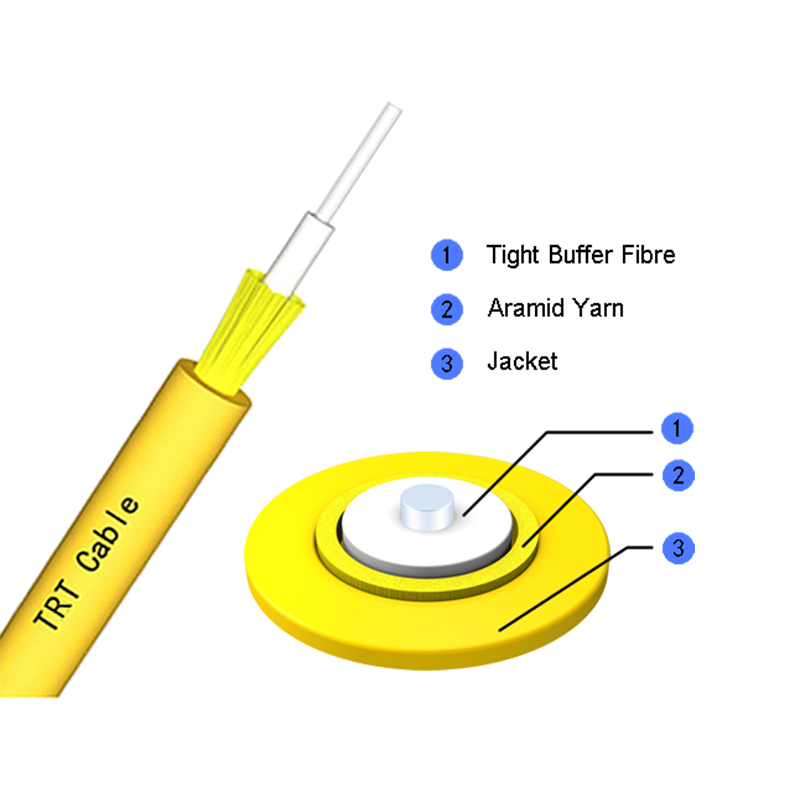
A 900-micron thermoplastic layer applied directly over the 250-micron coated fiber. Produces a stiff, robust unit that is easy to handle, strip, and terminate.
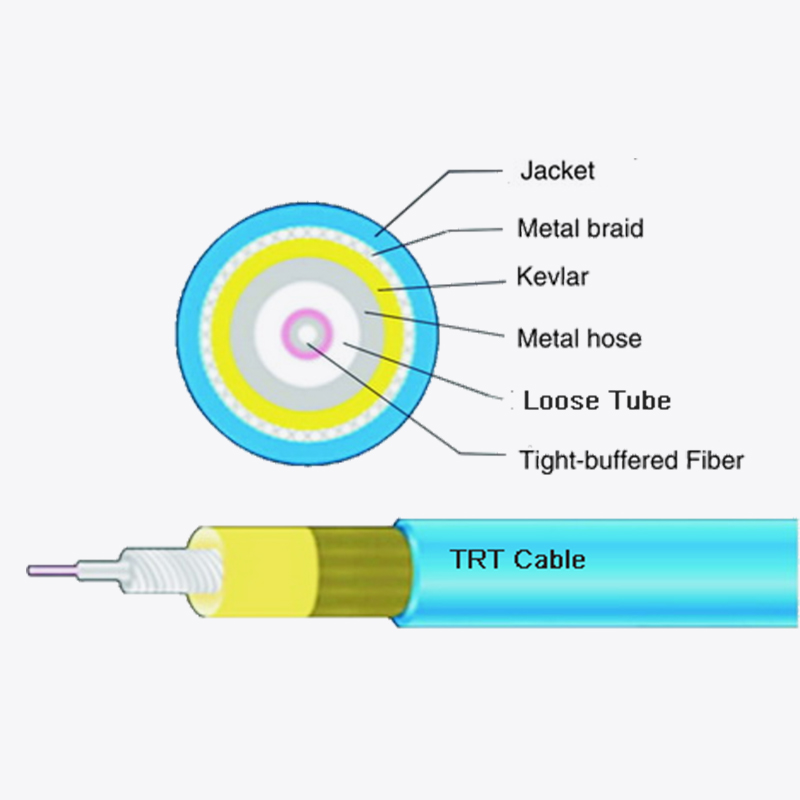
Fibers sit inside oversized gel-filled buffer tubes, decoupled from mechanical strain and temperature changes. Standard for outside plant and long-distance runs.
Multiple fibers bonded into flat arrays (4, 6, 8, or 12 wide). Enables mass-fusion splicing — all 12 fibers in one ribbon joined simultaneously in ~30 seconds versus 3–5 min per fiber individually.
Specialty Fiber Optic Cable Types
Beyond standard categories, a range of specialty cables addresses specific performance, safety, or environmental requirements. Misspecifying a standard cable where a specialty product is required leads to compliance failures or premature system degradation.
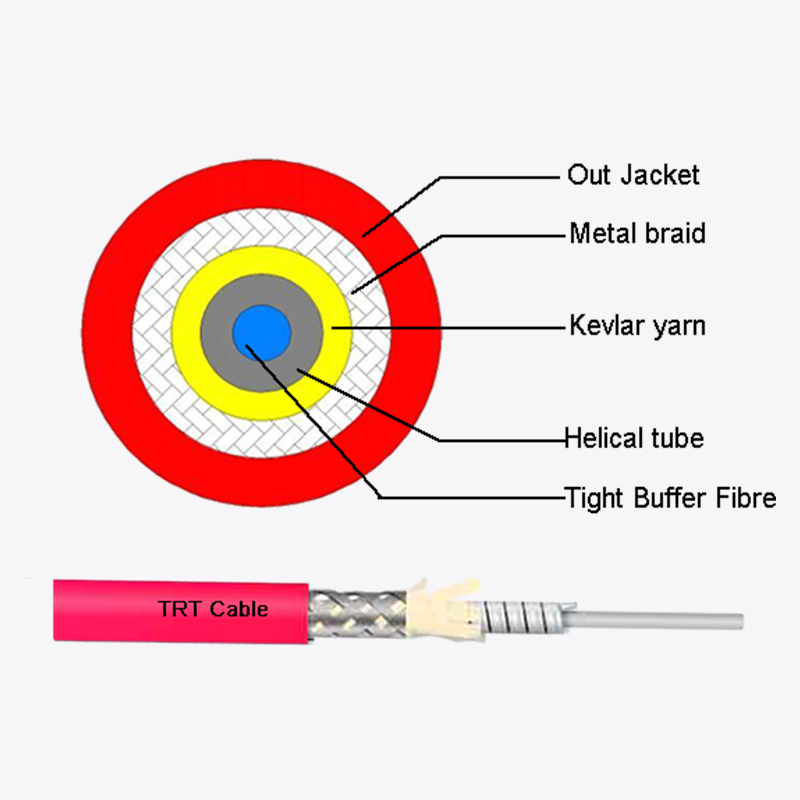
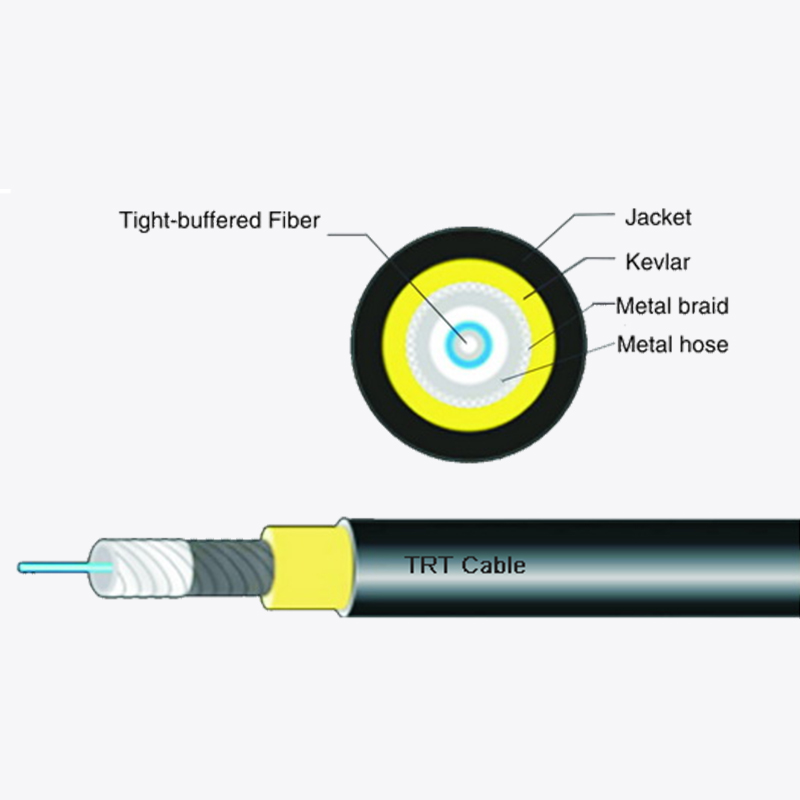
Interlocking metal armor — corrugated steel tape or aluminum — between the inner core and outer jacket. Provides crush resistance rated at 2,200 N or more and rodent resistance without rigid conduit. Popular in laboratories, machine rooms, and industrial facilities.
Mandatory in tunnels, ships, hospitals, and public transit where standard PVC jackets would release toxic halogen gases when burned. LSZH compounds produce minimal smoke and no corrosive gases. Required in many European building codes and increasingly specified in North American healthcare and transportation projects.
Uses a trench-assisted or nano-structured cladding index profile to confine light at bend radii as small as 7.5 mm without measurable signal loss. ITU-T grades G.657.A1 and G.657.A2 are standard in FTTH drop installations and tight in-building single-mode runs.
A non-circular or stress-rod core design maintains a single polarization axis over long distances. Used in fiber optic gyroscopes, interferometric sensors, and coherent DWDM systems where standard fiber's uncontrolled polarization state is unacceptable.
Ruggedized thermoplastic elastomer jackets rated from -40°C to +85°C, tensile loads up to 2,700 N, and engineered for repeated coiling and uncoiling in field environments. Typically 2–12 fiber count with ruggedized field-terminable connectors.
How to Select the Right Fiber Optic Cable
Selecting the correct cable is a multi-variable process. The flowchart below illustrates a structured decision path from application requirements to final specification.
Key Selection Criteria
Testing and Standards Compliance
Every fiber optic cable installation should be validated against recognized standards before being accepted into service. The primary testing methods and applicable standards are outlined below.
Launches a pulse into the fiber and measures reflections over time to map splice losses, connector events, and fiber breaks along the entire length. Primary tool for certifying OSP links, long riser runs, and any route where mid-span access would be difficult after commissioning.
TIA-526-14 (multimode) and TIA-526-7 (single-mode) define how to measure end-to-end insertion loss and return loss. A certified test set measures actual loss against the channel's calculated loss budget. A fail requires locating and correcting the high-loss event before sign-off.
Applicable Standards Reference
| Standard | Scope | Region |
|---|---|---|
| TIA-568.3-D | Optical fiber cabling components — structured cabling | North America |
| ISO/IEC 11801 | Generic cabling — Classes OF-300, OF-500, OF-2000 | International |
| IEC 60794 | Product specs for indoor, outdoor, and duct cables | International |
| ITU-T G.652 / G.657 | Standard and bend-insensitive single-mode fiber | International |
| UL 1666 / NFPA 262 | Fire tests for riser-rated and plenum-rated cables | North America |
Frequently Asked Questions
Q1: What is the difference between OM3 and OM4 multimode fiber?
Both use a 50 µm laser-optimized core, but OM4 has a higher overfilled launch bandwidth — 4,700 MHz·km versus 2,000 MHz·km for OM3. In practical terms, OM4 supports 100G over 150 meters compared to OM3's 100 meters. For new data center builds, OM4 is the recommended minimum because the incremental cost over OM3 is small relative to the extended reach and higher upgrade headroom it provides.
Q2: Can I use outdoor fiber optic cable indoors?
In most jurisdictions, outdoor cable cannot be run inside a building beyond a short transition distance — typically no more than 15 meters from the building entry point — without transitioning to a rated indoor cable. Outdoor HDPE jackets do not meet riser or plenum fire codes and release toxic fumes when burned. Use a dual-rated indoor-outdoor cable that carries the appropriate fire rating for the indoor portion of the run.
Q3: How do I read a fiber optic cable size chart?
Start by identifying your required fiber count, then confirm the outer diameter (OD) fits within your conduit's fill ratio — generally 40% of the conduit inner cross-section for a single cable. Check the minimum bend radius against the tightest turns in your route: exceeding this causes permanent signal loss. Finally, verify weight per kilometer against the pulling tension and span ratings of your cable tray or support system.
Q4: What connector should I use with a 100 ft fiber optic cable assembly?
LC duplex is standard for SFP, SFP+, and SFP28 transceivers used in 1G, 10G, and 25G equipment. SC is common on older telecom gear and passive distribution frames. For parallel optic modules — QSFP+ 40G, QSFP28 100G — you need an MPO/MTP connector carrying 8 or 12 fibers in one ferrule. Always verify the transceiver's optical interface specification before ordering a pre-terminated assembly.
Q5: Is single-mode or multimode fiber better for a campus network?
For inter-building links under 500 meters where 10G or 40G is the current speed, OM4 multimode is cost-effective because VCSEL transceivers are significantly less expensive than single-mode equivalents. For links over 500 meters, or where 100G direct-attach is planned, single-mode OS2 is the better long-term choice. Many campuses deploy single-mode in the outside plant backbone and multimode inside each building for horizontal and riser distribution.
Q6: What does OFNP mean and when is it required?
OFNP stands for Optical Fiber Non-conductive Plenum — the highest fire-resistance rating for indoor fiber cables. It is required in any plenum space used for air circulation in the HVAC system, such as the open space above a drop ceiling or beneath a raised floor. OFNP cables use low-smoke jacket materials meeting NFPA 262. Using a lower-rated cable in a plenum space violates building codes and creates a serious life-safety hazard.
Q7: How much spare fiber capacity should I install?
Best practice recommends at least 50% more fiber strands than currently needed — if your design requires 12 fibers, specify a 24-fiber cable. The incremental cost of additional strands during initial installation is minimal compared to the labor and disruption of pulling a second cable through an occupied building later. For campus backbone routes involving trenching, some network architects provision up to 100% spare because civil construction costs dominate the total project budget.
 Address:Zhong'an Road, Puzhuang Town, Suzhou City, Jiangsu Prov., China
 Phone:+86-189 1350 1815
 Tel:+86-512-66392923
 Fax:+86-512-66383830
 Email:[email protected]
 Wechat: xiaobin18913501815
 whatsapp: +86 18913501815

 0
0