
 English
 русский
 Español
 Português
 عربى
عربى


Multi-Purpose Break-Out Fiber Optic Cable vs Distribution Cable Guide
Understanding Multi-Purpose Break-Out Fiber Optic Cable
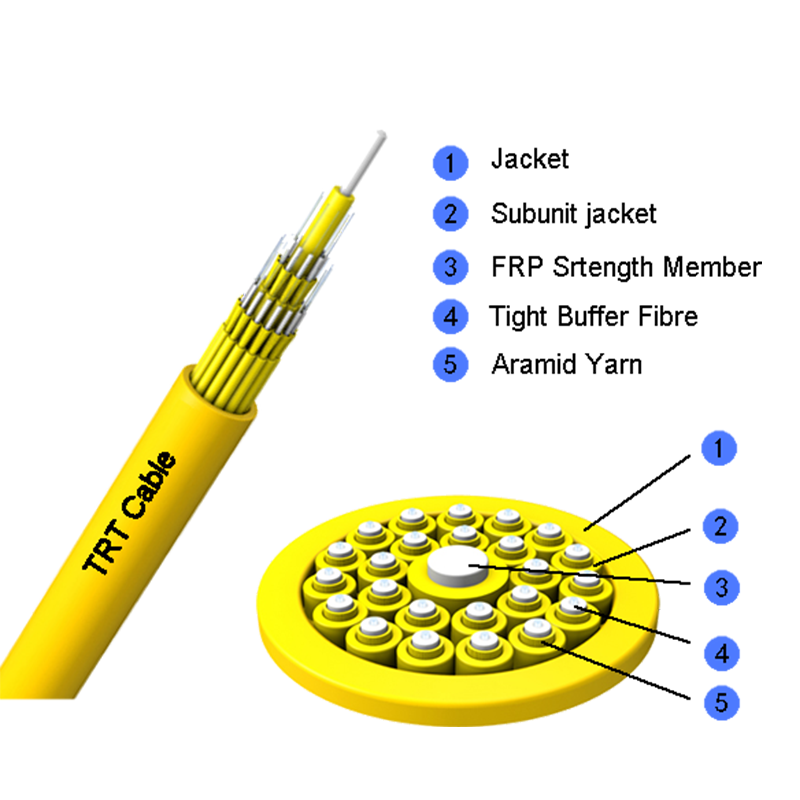
A Multi-Purpose Break-Out fiber optic cable represents a specialized tight-buffered cable design that combines multiple individual simplex cables within a single outer jacket. This cable type is also commonly referred to as fan-out cable due to its unique ability to separate into individual fiber lines at termination points.
The fundamental construction of break-out cable consists of two or more simplex subunits bundled around a central strength member. Each optical fiber is individually protected with its own 2.0mm to 3.0mm diameter jacket, providing robust mechanical protection. These subunits are then wrapped with aramid yarn strength members and encased in an overall outer jacket, creating a highly durable cable assembly. Fiber counts typically range from 2 to 24 fibers, with some configurations extending up to 48 fibers for high-density applications.
Key Structural Components
The multi-purpose break-out cable incorporates several critical components that distinguish it from other cable types:
- 900μm tight-buffered fibers at the core provide primary protection
- Individual subunit jackets (2.0mm or 3.0mm) for each fiber
- Central strength member (FRP or steel) for tensile support
- Aramid yarn (Kevlar) surrounding subunits for additional strength
- Outer jacket in PVC, LSZH, or plenum-rated materials
What Is Distribution Fiber Optic Cable
Distribution fiber optic cable represents the most widely deployed indoor cable type, characterized by its compact size and lightweight construction. Unlike break-out cable, distribution cable contains multiple tight-buffered fibers bundled directly under a single outer jacket without individual subunit protection for each fiber.
The typical construction features 900μm tight-buffered fibers grouped together with aramid yarn strength members, all contained within a single jacket. This design enables significantly higher fiber density, with configurations available from 2 fibers up to 144 fibers or more in some specialized applications. The compact nature of distribution cable makes it ideal for space-constrained installations.
Distribution Cable Construction Variants
Distribution cables come in two primary construction formats:
- Non-unitized construction: All fibers bundled together directly under the outer jacket
- Unitized construction: Fibers organized into sub-groups or units for easier identification and handling
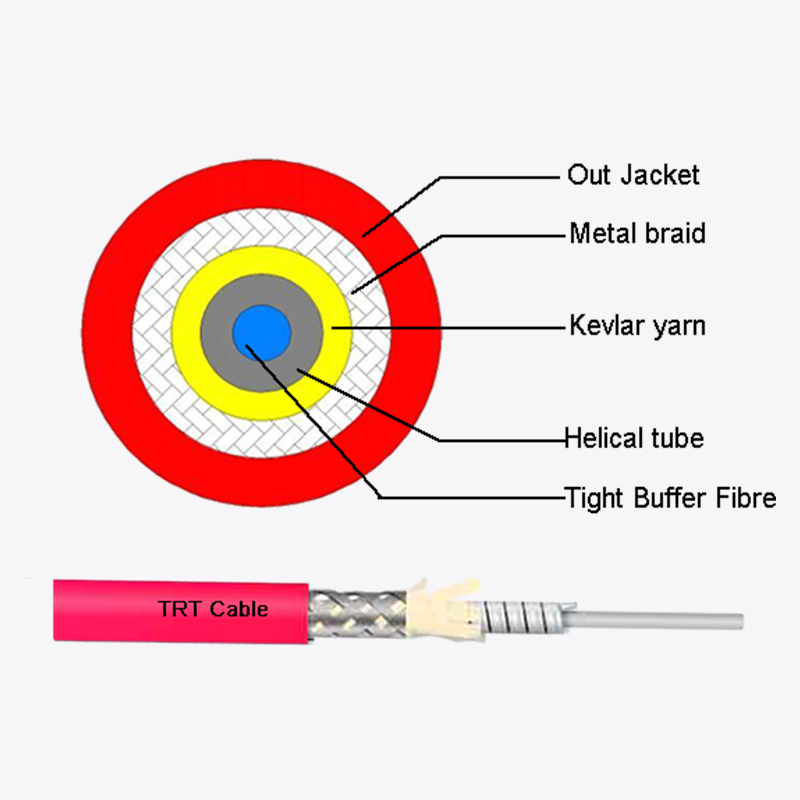
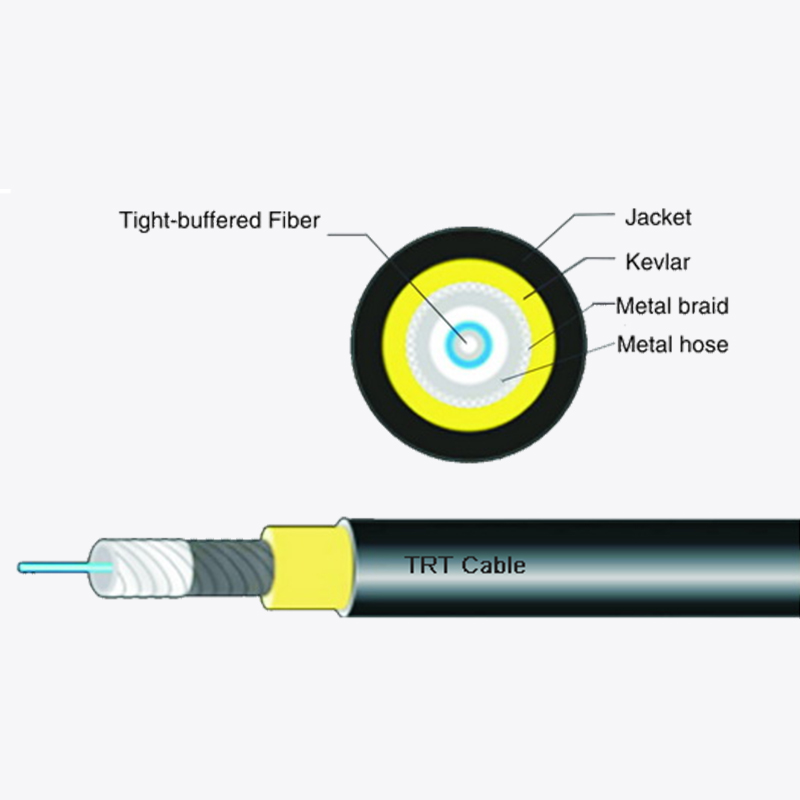
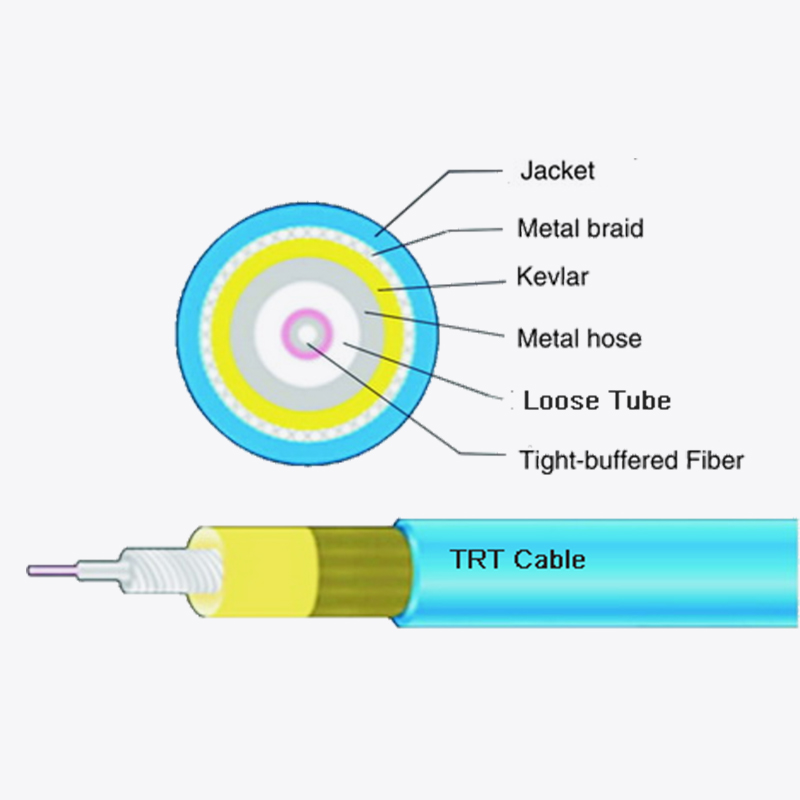
Distribution cables are available in both standard and armored versions. Armored distribution cables feature an additional protective layer, making them suitable for harsh premise environments where heavy-duty protection against crushing or rodent damage is required.
Critical Differences Between Break-Out and Distribution Cables
Understanding the distinctions between these two cable types is essential for selecting the appropriate solution for specific networking requirements. The following comparison highlights the primary differentiating factors:
| Feature | Multi-Purpose Break-Out Cable | Distribution Cable |
| Fiber Protection | Individual 2.0-3.0mm subunit jackets | Shared outer jacket only |
| Typical Fiber Count | 2 to 24 fibers | 2 to 144+ fibers |
| Cable Diameter | Larger, bulkier construction | Compact, smaller diameter |
| Flexibility | Less flexible due to subunits | Highly flexible |
| Termination Method | Direct connector termination | Requires patch panel or breakout box |
| Cost | Higher material cost, lower labor cost | Lower material cost, higher labor cost |
| Ruggedness | Superior mechanical protection | Standard protection |
Physical Characteristics Comparison
The physical dimensions of these cables differ significantly. A typical 12-fiber break-out cable may have an outer diameter of 8.0mm to 10.0mm, while an equivalent distribution cable might measure only 5.0mm to 6.5mm. This size difference directly impacts conduit fill capacity and routing flexibility in tight spaces.
Weight is another distinguishing factor. Break-out cables typically weigh 30% to 50% more per meter than distribution cables of equivalent fiber count due to the additional jacketing material. This weight difference becomes significant in vertical riser applications and long-distance installations.
Termination and Installation Considerations
Break-Out Cable Termination Advantages
The primary advantage of multi-purpose break-out cable lies in its termination efficiency. Because each fiber is already protected with a robust 2.0mm or 3.0mm subunit jacket, installers can directly attach connectors without additional protective tubing or breakout kits. This design eliminates the need for:
- Breakout boxes or fan-out kits
- Splice trays for individual fiber protection
- Additional 900μm to 2.0mm buffer tubing
- Patch panels for intermediate protection
This direct termination capability can reduce installation time by 40% to 60% compared to distribution cable installations requiring breakout hardware. The labor savings often offset the higher material cost of break-out cable in installations with limited fiber counts.
Distribution Cable Termination Requirements
Distribution cables require additional hardware for safe termination. Since the 900μm tight-buffered fibers lack individual reinforcement beyond the aramid yarn, they must be terminated within protective enclosures. The standard termination process involves:
- Routing the cable to a patch panel or junction box
- Stripping the outer jacket to expose tight-buffered fibers
- Installing breakout kits or protective tubing (900μm to 2.0mm)
- Terminating connectors on the protected fibers
- Organizing connections within the enclosure
While this process requires more steps, distribution cables excel in high-density applications where multiple fibers terminate at a single location, such as data center main distribution areas or telecommunications rooms.
Application Scenarios and Selection Guidelines
Optimal Applications for Multi-Purpose Break-Out Cable
Break-out cables are the preferred choice in scenarios requiring maximum durability and direct termination capabilities:
- Industrial environments: Factory floors, manufacturing plants, and automation systems where cables may encounter mechanical stress, abrasion, or exposure to oils and chemicals
- Direct equipment connections: Running from a central patch panel directly to individual workstations or equipment without intermediate junction boxes
- Conduit installations: Short to medium runs through conduit systems where cable ruggedness is prioritized over space efficiency
- Riser applications: Vertical runs between floors where individual fiber breakout may be required at various levels
- Local data centers: Small to medium facilities where fiber counts per run remain below 24 fibers
Optimal Applications for Distribution Cable
Distribution cables excel in high-density, space-constrained installations:
- Intra-building backbones: Horizontal and vertical cabling between telecommunications rooms with high fiber count requirements
- Data center EDA areas: Equipment distribution areas where multiple fibers converge at patch panels
- FTTD (Fiber to the Desk): Horizontal distribution systems serving multiple outlets from a central point
- Space-constrained conduits: Installations where maximizing fiber density within limited conduit space is critical
- Inter-building campus cabling: Connections between buildings where cable volume and weight impact installation costs
Fire Safety Ratings and Environmental Compliance
Both cable types are available with various fire safety ratings to comply with building codes and installation environments. The National Electrical Code (NEC) Article 770 defines these ratings for optical fiber cables:
Common Flame Ratings Available
| Rating | Description | Typical Applications |
| OFNP (Plenum) | Optical Fiber Nonconductive Plenum | Air handling spaces, ducts, plenums |
| OFNR (Riser) | Optical Fiber Nonconductive Riser | Vertical shafts, between floors |
| OFNG (General) | Optical Fiber Nonconductive General | General purpose indoor use |
| LSZH | Low Smoke Zero Halogen | Public buildings, confined spaces |
Plenum-rated cables feature fire-retardant jackets that release minimal smoke and toxic gases when exposed to flames, making them essential for installation in environmental air handling spaces. Riser-rated cables provide enhanced fire resistance for vertical applications but do not meet the stringent low-smoke requirements of plenum spaces.
LSZH jackets have gained popularity in public buildings, transportation infrastructure, and confined spaces where smoke emission and toxic gas release during fire events pose significant safety hazards. Both break-out and distribution cables are readily available with LSZH jacketing materials.
Cost Analysis and Total Cost of Ownership
When evaluating cable options, considering only material costs can lead to suboptimal decisions. A comprehensive total cost of ownership analysis should include material costs, installation labor, termination hardware, and maintenance requirements.
Material Cost Comparison
Break-out cables typically cost 20% to 40% more per meter than equivalent distribution cables due to the additional jacketing material required for each fiber subunit. For a 12-fiber cable, this premium might range from $0.50 to $1.50 per meter depending on specifications and flame ratings.
Installation Cost Factors
The labor differential significantly impacts overall project costs. Installing and terminating break-out cables requires approximately 15 to 30 minutes per fiber for direct connector attachment. Distribution cable installations requiring breakout boxes, protective tubing, and patch panel terminations typically demand 45 to 90 minutes per fiber when all termination steps are included.
For a 12-fiber installation, this labor differential can result in cost savings of $200 to $500 per cable run when using break-out cable, often more than offsetting the material cost premium. However, for high-fiber-count backbone cables (48+ fibers) terminating at centralized patch panels, distribution cables remain more economical due to the efficiency of mass termination in controlled environments.
Hardware Cost Considerations
Break-out cable installations can eliminate or reduce the need for:
- Breakout boxes ($50 to $150 per location)
- Fan-out kits ($10 to $25 per fiber)
- Additional patch panels ($100 to $300 per panel)
- Protective tubing and accessories ($2 to $5 per fiber)
Performance Characteristics and Specifications
Both cable types utilizing tight-buffered fibers offer excellent optical performance characteristics suitable for modern high-speed networks. The 900μm tight-buffered construction provides low attenuation and reliable signal transmission.
Mechanical Performance Specifications
Break-out cables demonstrate superior tensile strength due to their robust construction. Typical specifications include:
- Tensile strength: 500N to 1000N (short term) for standard break-out cables
- Crush resistance: 1000N/100mm to 2000N/100mm due to subunit protection
- Bend radius: 10x cable diameter (static), 20x cable diameter (dynamic)
- Operating temperature: -20°C to +60°C for standard indoor ratings
Distribution cables offer competitive mechanical performance with emphasis on flexibility:
- Tensile strength: 200N to 600N (short term) depending on fiber count
- Crush resistance: 500N/100mm to 1000N/100mm (standard versions)
- Bend radius: 10x cable diameter (static), 15x to 20x cable diameter (dynamic)
- Armored versions: Crush resistance up to 3000N/100mm available
Optical Performance
Both cable types support standard single-mode (OS1/OS2) and multimode (OM1/OM2/OM3/OM4/OM5) fiber types. Attenuation characteristics follow standard fiber specifications, with tight-buffered cables typically exhibiting:
- Single-mode: ≤0.36dB/km at 1310nm, ≤0.22dB/km at 1550nm
- Multimode OM3: ≤3.0dB/km at 850nm, ≤1.0dB/km at 1300nm
- Multimode OM4: ≤3.0dB/km at 850nm, ≤1.0dB/km at 1300nm
Frequently Asked Questions
Q1: Can break-out cable be used for outdoor applications?
Standard multi-purpose break-out cables are designed for indoor use. However, specialized indoor/outdoor versions with UV-resistant jackets and enhanced moisture protection are available for applications requiring direct burial or aerial installation.
Q2: What is the maximum fiber count available in break-out cables?
Break-out cables typically accommodate 2 to 24 fibers in standard configurations. High-density versions may extend to 48 fibers, though cable diameter and flexibility become limiting factors beyond 24 fibers.
Q3: Why does distribution cable require a breakout box for termination?
Distribution cable contains 900μm tight-buffered fibers without individual subunit jackets. The breakout box or fan-out kit provides protective tubing that increases fiber diameter to 2.0mm, enabling safe connector attachment and strain relief.
Q4: Which cable type is better for data center applications?
The choice depends on the specific data center zone. Distribution cables excel in main distribution areas with high fiber counts converging at patch panels. Break-out cables are ideal for equipment distribution areas requiring direct equipment connections without intermediate panels.
Q5: Are break-out and distribution cables compatible with the same connectors?
Yes, both cable types use standard fiber optic connectors (LC, SC, ST, FC, MPO). Break-out cables accommodate connectors directly on the 2.0mm or 3.0mm subunits, while distribution cables require 2.0mm protective tubing before connector installation.
Q6: How do I calculate the minimum bend radius for these cables?
The minimum bend radius is calculated as a multiple of cable outer diameter. For static installation, use 10x the cable OD. For dynamic conditions or during installation, use 15x to 20x the cable OD. Always consult manufacturer specifications for exact values.
Q7: Can I mix break-out and distribution cables in the same installation?
Yes, many installations benefit from hybrid deployments. Use distribution cables for high-density backbone runs between telecommunications rooms, and break-out cables for the final drops to individual workstations or equipment where direct termination is advantageous.
 Address:Zhong'an Road, Puzhuang Town, Suzhou City, Jiangsu Prov., China
 Phone:+86-189 1350 1815
 Tel:+86-512-66392923
 Fax:+86-512-66383830
 Email:[email protected]
 Wechat: xiaobin18913501815
 whatsapp: +86 18913501815

 0
0