
 English
 русский
 Español
 Português
 عربى
عربى


How to Choose Strength Members for Bow-type Drop Cables: FRP vs Steel Wire – A Technical Comparison
1. Introduction: Why Strength Members Matter in Bow-Type Drop Cables
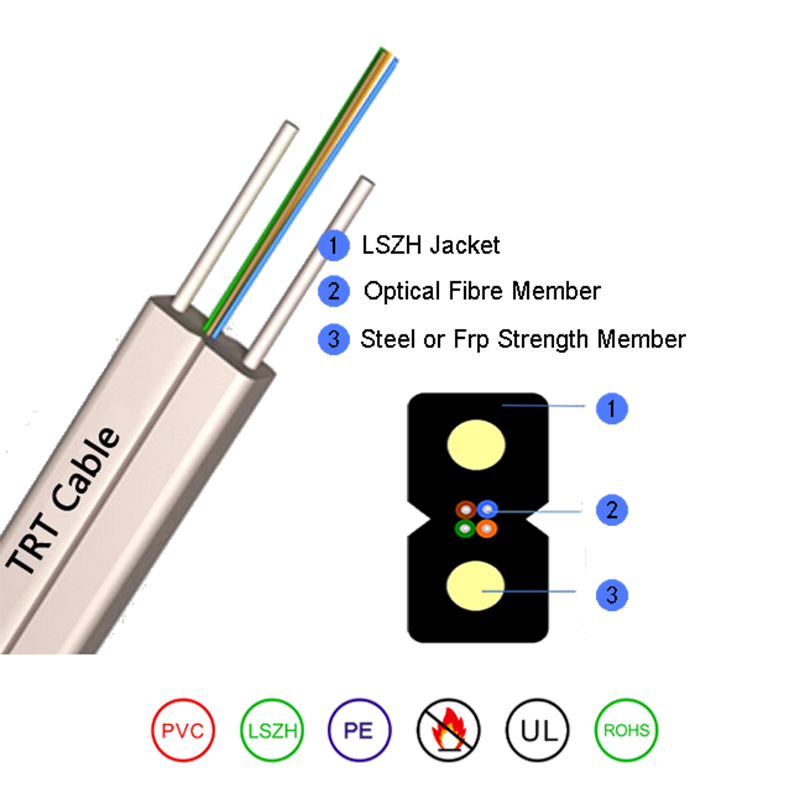
The rapid expansion of FTTH networks has increased the demand for reliable drop cables. Among various designs, the Bow-type drop cable (also known as butterfly type drop cable) is widely adopted due to its compact structure, easy separation, and low installation cost. A critical component in these cables is the strength member, which provides tensile resistance, protects optical fibers during installation, and ensures long-term mechanical stability.
Two dominant material choices exist for strength members in FTTH drop fiber optic cables: galvanized steel wire and Fiber-Reinforced Polymer (FRP). While steel wire has been the conventional solution, FRP rods (glass or aramid reinforced) are gaining traction in non-metallic versions such as GJXFH drop cable. Understanding their differences is essential for network designers, installers, and procurement engineers. This article delivers a data-driven, side-by-side comparison of FRP vs steel wire strength members specifically for bow-type drop cables.
We will examine mechanical properties, environmental behavior, bending fatigue, creep resistance, weight economics, and compatibility with existing field termination practices. Realistic performance data and industry observations (without referencing specific brands) will guide your material selection for Butterfly type drop cable and GJXH/GJXFH variants.
2. Mechanical Properties: Tensile Strength, Modulus and Strain Behavior
The primary function of a strength member is to carry tensile loads without transferring excessive strain to the optical fibers. Both steel wire and FRP offer high tensile strength, but their stress-strain curves differ significantly.
2.1 Tensile Strength and Modulus Comparison
Steel wire used in drop cables typically exhibits a tensile strength ranging from 1500 MPa to 1770 MPa, with an elastic modulus around 200 GPa. FRP (glass fiber reinforced polymer) shows tensile strength between 600 MPa and 1200 MPa depending on fiber volume fraction, while its modulus lies in the range of 35–50 GPa. However, FRP’s lower density (≈1.9 g/cm³) compared to steel (≈7.8 g/cm³) compensates for its lower absolute strength when weight-specific performance is considered.
The following table summarizes typical room-temperature properties for strength members used in bow-type drop cables.
| Property | Steel Wire (Galvanized) | FRP Rod (Glass FRP) |
|---|---|---|
| Tensile strength (MPa) | 1500 – 1770 | 700 – 1100 |
| Elastic modulus (GPa) | 200 | 40 – 45 |
| Density (g/cm³) | 7.85 | 1.9 – 2.1 |
| Specific strength (kN·m/kg) | 190 – 225 | 350 – 520 |
| Breaking elongation (%) | 3 – 4 | 1.8 – 2.5 |
| Minimum bending radius (mm, for 2 mm rod) | ≈30 | ≈20 |
Steel offers higher absolute tensile strength and stiffness, which is advantageous for long-span aerial installations. However, the higher specific strength of FRP means that for the same weight, FRP can actually support greater loads – a critical factor in reducing overall cable mass and facilitating easier handling in FTTH drop networks.
2.2 Strain Transfer to Optical Fibers
In a bow-type drop cable, two strength members are placed symmetrically beside the fiber subunit. When a tensile load is applied, strain is primarily taken by the strength members. Because steel has a higher modulus, a small elongation results in higher stress; but steel’s higher breaking strain margin (≈3%) provides a safety buffer before fiber fracture (typical fiber strain limit 0.5 – 0.8%). FRP’s lower modulus and lower breaking strain (≈2%) require more careful tension control during pulling. Field data from large-scale FTTH projects indicate that properly designed FRP-based GJXFH cables can be safely installed with pulling tensions up to 500 N without fiber stress issues, while steel-reinforced GJXH cables can handle up to 800 N. The choice depends on deployment topography.
3. Environmental Durability: Corrosion, Moisture and Temperature Effects
Drop cables are often exposed to outdoor environments, including humidity, airborne salts, and temperature cycles. Corrosion resistance becomes a deciding factor for long service life (typically 20–30 years).
3.1 Corrosion and Chemical Resistance
Steel wire, even with galvanized coating, is susceptible to corrosion when the zinc layer is compromised by scratches or micro-cracks during bending. In coastal or industrial areas, corrosion can lead to strength degradation and eventual failure. Accelerated salt-spray tests (ASTM B117) show that conventional galvanized steel wire begins to show red rust after 200–300 hours, while heavy-duty coatings extend this to 500 hours. In contrast, FRP rods are inherently inert to chlorides, acids, and alkalis. No significant strength loss is observed after 2000 hours of salt-spray exposure. For FTTH deployments in harsh environments, GJXFH drop cable (FRP based) eliminates the need for grounding and provides lifelong corrosion resistance.
3.2 Temperature and UV Performance
Steel has consistent mechanical properties from -40°C to +80°C, with a coefficient of thermal expansion (CTE) ≈12×10⁻⁶/K. FRP has a CTE varying between 6–10×10⁻⁶/K, closely matching the fiber’s CTE (≈0.55×10⁻⁶/K in axial direction) but with some mismatch in radial direction. This similarity reduces microbending losses in low‑temperature conditions. However, unprotected FRP can degrade under prolonged UV exposure. In practice, bow-type drop cables utilize a black LSZH or PE sheath with added carbon black, fully shielding the strength member. Under such protection, FRP maintains >95% of its initial strength after 10 years of outdoor weathering. Steel does not suffer UV degradation, but corrosion remains its limiting factor.
4. Bending Flexibility and Installation Considerations
Bow-type drop cables often require tight bends around corners, inside multi-dwelling units, or in aerial lashed installations. The ability to bend without damaging the strength member or inducing fiber attenuation is crucial.
4.1 Minimum Bending Radius
FRP rods have a smaller critical bending radius compared to steel wire of the same diameter. For a 1.2 mm FRP strength member, sustained bending down to 15 mm radius (≈12.5× diameter) does not cause fracture, while steel wire under the same condition may experience plastic deformation or work hardening. This makes FRP-reinforced butterfly type drop cables more suitable for in-home routing where tight spaces are common.
4.2 Installation Tension and Handling Fatigue
During cable pulling, repeated pulleys and low-temperature coiling can induce fatigue in steel wire. Case studies from European FTTH projects show that after 100 cycles of bending over a 30 mm mandrel, steel strength members lose about 8-12% of their breaking load due to microcracks in the zinc coating and steel substrate. FRP, being a composite, exhibits less fatigue sensitivity; after 200 cycles over the same mandrel, residual strength remains above 92%. However, FRP is more notch-sensitive – deep scratches during handling can initiate fracture. Therefore, installation practices for FRP-based GJXFH cables should avoid sharp edge contact.
5. Long-Term Reliability: Creep and Aging Performance
Strength members experience sustained stress for decades due to cable tension, wind, and ice loading. Creep deformation can gradually transfer strain to the optical fibers, increasing attenuation.
5.1 Creep Behavior at Elevated Temperatures
Steel has excellent creep resistance up to 150°C; under typical drop cable working temperatures (max 70°C), creep strain is negligible (<0.01% over 30 years). FRP composites exhibit viscoelastic creep, especially at higher stress levels. Standard creep tests per ASTM D2990 show that glass FRP under 30% of ultimate tensile strength (UTS) produces creep strain of 0.2–0.5% after 10,000 hours, corresponding to approximately 0.5–1.2% after 30 years extrapolation. This can potentially exceed the strain budget of single-mode fibers if cable design does not accommodate initial slack. Manufacturers counter this by pre-slacking fibers within the bow-type cable (e.g., 0.5–0.8% excess length). For most FTTH applications where sustained tensions are below 20% UTS, both materials provide acceptable long-term performance.
5.2 Aging & Alkaline Attack in Wet Environments
Glass FRP is susceptible to alkaline attack in high pH conditions (e.g., from cement dust or certain ground waters). Hydrolysis of the glass fiber surface can reduce tensile strength by 20-30% over decades if moisture and alkalinity coexist. Steel, in contrast, fails by corrosion in the same environment. For underground duct installations, both materials require a robust sheath; however, FRP’s long-term performance in neutral or slightly acidic conditions is superior. Data from 25-year-old telecom cables show that FRP rods in dry indoor conditions retained >90% of original strength, while galvanized steel in the same cables showed minor surface rust but functional integrity remained. Choose based on the specific deployment environment.
6. Weight, Cost and Logistics Efficiency
Reducing cable weight directly impacts shipping costs, installer fatigue, and ease of aerial lashing. A standard 2‑fiber bow-type drop cable using two 1.0 mm steel wires weighs approximately 28 kg/km. Replacing steel with FRP (same diameter) reduces weight to approximately 14 kg/km – a 50% reduction. For a large FTTH project deploying 500 km of drop cable, this translates to 7,000 kg less weight, lowering fuel consumption and warehouse handling requirements.
In terms of raw material cost, steel wire currently has a lower per-kilogram price than high-quality FRP rods. However, when comparing on a per-cable-length basis, the difference is diminishing because FRP’s lower density means less material mass per meter. Additionally, FRP cables eliminate the need for grounding and corrosion mitigation (e.g., avoiding direct contact with dissimilar metals). Life-cycle cost analysis for a 15-year network horizon often favors FRP in aggressive environments due to reduced maintenance and replacement.
- Steel advantage: Lower upfront material cost; familiar termination hardware; higher absolute tensile capacity.
- FRP advantage: 50% lighter; corrosion-proof; no grounding required; smaller bending radius; easier handling.
7. Application-Specific Guidance: GJXH vs GJXFH Standards
Industry standard designations for bow-type drop cables often reflect the strength member type:
- GJXH fiber optic cable – Typically uses steel wire as strength members (metallic design). Suitable for aerial or duct installations where maximum tensile load is critical and lightning protection can be arranged. Requires proper grounding to avoid current induction.
- GJXFH drop cable – Fully dielectric with FRP strength members. Ideal for premises cabling, indoor/outdoor transition, and locations where lightning strike risk is high or where electrical isolation is mandatory (e.g., cell towers, railway side).
Field data from a 200-km FTTH rollout in coastal region: The operator initially deployed steel-reinforced GJXH but observed rust staining at mid-span joints after 18 months. Replacement with FRP-based GJXFH completely resolved the issue, albeit with a 9% higher initial cable cost – but total cost of ownership after 5 years became 15% lower due to zero corrosion-related failures.
For standard indoor applications, the flexibility of FRP simplifies routing inside risers and tight corners, making Butterfly type drop cable with FRP the preferred choice of many European and Asian telcos.
8. Decision Matrix: FRP vs Steel Wire Strength Members
The following table provides a quick-reference guide for engineers when selecting strength members for bow-type drop cables.
| Selection Criterion | Steel Wire | FRP |
|---|---|---|
| Highest pulling tension required (>600 N) | Preferred | — Limited (use larger rod) |
| Light weight & handling ergonomics | — | Best |
| Corrosive environment (coastal, industrial) | — (requires special coating) | Excellent |
| Tight bending radius (<20 mm) | — Risk of kinking | Suitable |
| Cost-sensitive project with short lifespan (≤10 years) | Lower initial cost | — |
| Lightning-prone area & need for dielectric cable | — Not allowed | Mandatory |
| Ease of connectorization/field termination | Standard tools | FRP shears required |
Often a hybrid approach is unnecessary – pick based on the dominant environmental and mechanical requirement. For most FTTH drop scenarios where cables are exposed to weather and occasional high tension, FRP provides a more future-proof balance. Steel remains relevant for very long-span aerial drops in non-corrosive rural areas.
9. Frequently Asked Questions (FAQ)
Q1: Can I directly replace steel strength members with FRP in an existing bow-type cable design?
Direct replacement requires requalification of the cable’s tensile rating, bending performance, and connector attachment method. The lower modulus of FRP may alter fiber strain margins, so a redesign of the cable’s excess fiber length is often needed. Always consult design standards (e.g., IEC 60794-1-2) before substitution.
Q2: Does FRP strength member affect the flammability rating of indoor drop cables?
FRP itself is a thermoset composite with limited flammability contribution. When combined with LSZH sheaths, the overall cable can achieve UL 1685 vertical tray flame test compliance. Steel does not burn but may conduct heat. Both can meet riser or plenum ratings, but always check the full cable certification.
Q3: Are there special tools required to terminate FRP-reinforced bow-type cables?
Yes. Steel wires can be cut with standard wire cutters. FRP rods require carbide blade cutters or special FRP shears to prevent splitting. Mechanical connectors for FRP-based GJXFH cables are available and use a clamping mechanism rather than crimping. Field training is recommended.
Q4: How does the long-term cost of FRP compare to steel including maintenance?
Initial cost of FRP is typically 8–15% higher per cable meter. However, FRP eliminates grounding hardware, corrosion inspections, and premature replacements. For a 20-year network life, total ownership cost for FRP is 10–20% lower in aggressive environments and roughly equal in dry, benign conditions.
Q5: Can FRP strength members be used for self-supporting aerial bow-type drop cables?
Yes, but the tensile rating must be carefully chosen. Many self-supporting designs incorporate a messenger wire separate from the strength members. For all-dielectric self-supporting (ADSS) style drop cables, FRP is the standard choice. For heavy ice or wind loading, larger diameter FRP rods or steel messaging can be employed.
10. Conclusion: Engineering the Right Choice
Both FRP and steel wire strength members have proven their reliability in millions of kilometers of FTTH drop cables. The decision rests on specific project parameters: required tensile headroom, environmental corrosivity, weight limits, lightning safety, and cost constraints. FRP excels in lightweight, corrosion-proof, dielectric applications – making it the go-to for modern GJXFH drop cables and indoor butterfly type cables. Steel remains a robust, cost-effective solution where maximum tensile strength is needed and corrosion can be managed. By understanding the comparative data presented in this article, network engineers can confidently specify strength members that optimize performance and total cost of ownership for Bow-type drop cable deployments.
 Address:Zhong'an Road, Puzhuang Town, Suzhou City, Jiangsu Prov., China
 Phone:+86-189 1350 1815
 Tel:+86-512-66392923
 Fax:+86-512-66383830
 Email:[email protected]
 Wechat: xiaobin18913501815
 whatsapp: +86 18913501815

 0
0