
 English
 русский
 Español
 Português
 عربى
عربى


How Micro Fiber Indoor Cable (≤24f) Delivers Future-Proof Bandwidth for Enterprise Networks
1. The Bandwidth Cliff: Why Traditional Cabling Fails Modern Enterprises
Enterprise networks face an exponential surge in data consumption. Video collaboration, IoT sensors, AI workloads, and edge computing are doubling bandwidth requirements every 24 to 36 months in many organizations. A typical medium-sized campus now sees annual traffic growth of 35–40%, pushing legacy copper and conventional fiber infrastructures to their limits. Standard 12-strand loose-tube cables, while reliable, occupy substantial conduit space and require bulky bend radius clearances. When a company upgrades from 1 GbE to 10 GbE or 40 GbE to the access switch, the physical plant often becomes the bottleneck – not the electronics.
Building owners frequently face costly retrofitting: pulling new cables through congested risers, drilling additional pathways, or even abandoning old conduits. The real pain point is density. Traditional indoor fiber cables with 12 fibers often use 3 mm to 4 mm outer diameters, limiting a standard 25 mm conduit to maybe three cables (36 fibers total). As 400 GbE and 800 GbE standards mature, fiber counts per link will rise, making legacy approaches unsustainable. What is needed is a solution that shrinks cable footprint, boosts fiber density, and adapts to future speeds without repeated demolition. That is precisely where Micro Fibre Indoor Cable MFC≤24f transforms the game.
2. What Is Micro Fiber Indoor Cable? Breaking the Density Barrier
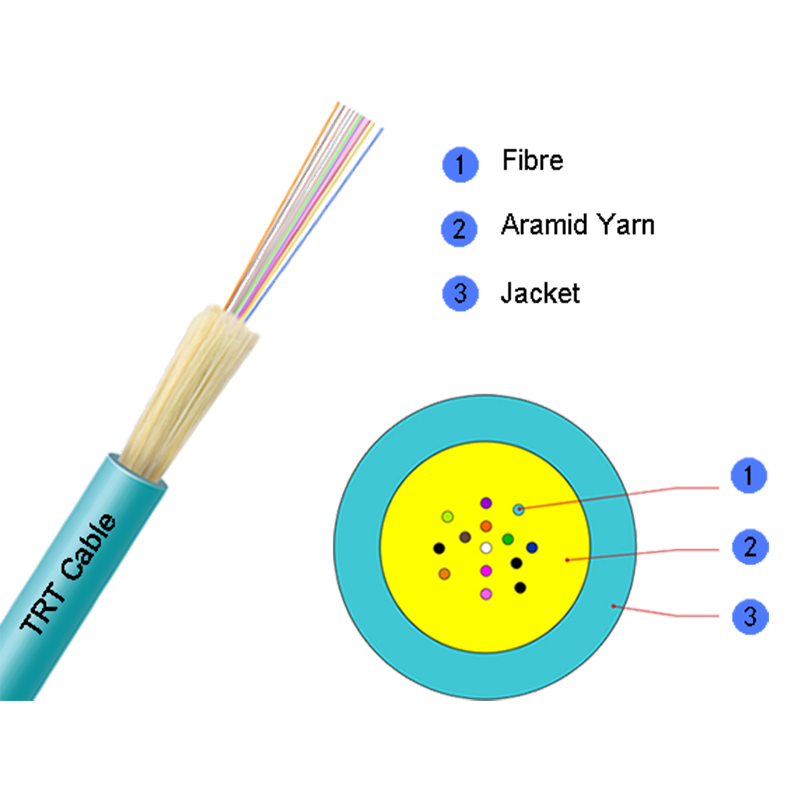
Indoor micro fiber optic cable refers to ultra-compact, high-fiber-count cabling that uses 200 µm or 250 µm coated fibers with advanced strength members and thin-walled LSZH or Plenum sheaths. Unlike traditional constructions with separate buffer tubes and thick jackets, micro cable designs eliminate redundant layers. The result: a cable containing 24 fibers (e.g., 24 strand indoor fiber optic cable) can have an outer diameter as low as 3.8 mm to 4.5 mm – similar to a standard 6‑fiber distribution cable. This density improvement allows up to four times the fiber count in the same conduit area.
For enterprise facilities managers, this means future bandwidth upgrades are a matter of changing optics, not ripping out pathways. The 24f micro fiber cable is rapidly becoming the default choice for new build and retrofit projects because it supports both legacy multimode (OM3/OM4) and single-mode (OS2) fibers within the same tiny footprint. Additionally, micro cable constructions maintain full compliance with fire safety codes: LSZH indoor micro cable (Low Smoke Zero Halogen) for European and international markets, and Plenum indoor micro fiber cable for air-handling spaces in North America. Therefore, no compromise on safety or performance is required to achieve high density.
Table 1: Physical Footprint Comparison (12 vs 24 fibers)
| Parameter | Traditional 12f Loose Tube | Micro 24f Indoor Cable |
|---|---|---|
| Outer Diameter (mm) | 5.5 – 7.0 | 3.8 – 4.5 |
| Min Bend Radius (mm) | 85 (static) | 45 (static) |
| Weight (kg/km) | ~45 | ~22 |
| Fibers per 25mm conduit | ~36 (3 cables) | ~144 (6 cables, 24f each) |
| Tensile strength (N) | 400 | 300 (sufficient for indoor) |
As shown, micro fiber increases fiber density by 300% while reducing bend radius limitations. This flexibility allows installers to route cables along tight corners, under raised floors, and through existing risers without special tools. Consequently, capital expenditure (CAPEX) for pathway modifications drops significantly.
3. How Micro Cable Construction Future‑Proofs Bandhead Growth
Future-proofing hinges on three pillars: scalable fiber count, modular connectivity, and multi‑generation transmission support. Micro fiber indoor cable excels in all three. First, by squeezing 24 strands into a jacket no thicker than a pencil, enterprises can install spare fibers at marginal extra cost. A single pull of Indoor micro fiber optic cable with 24 fibers provides enough logical paths for today’s trunk (e.g., 2x 10G uplinks) plus six future 400G links (using 4 fibers per 400GBASE‑SR8). Alternatively, the fibers can be broken out into separate MPO‑12 or MPO‑24 connectors, enabling parallel optics.
Second, pre-terminated indoor fiber cable versions of micro cable take future-proofing a step further. Factory‑terminated MPO or LC cassettes eliminate field splicing errors and allow “plug‑and‑play” upgrades. When an enterprise moves from 40G to 100G, only the transceivers and patch panels need replacement; the same pre‑terminated micro cable remains in place. Real‑world data: A 500‑desk corporate campus that deployed micro 24f pre‑terminated trunks reduced their upgrade time from three days to six hours when migrating from 1G to 10G to the desktop. The structured cabling infrastructure did not require any repulling.
Third, the use of bend‑insensitive fibers (ITU‑T G.657.A2) in micro cables ensures that even when future 800G or 1.6T coherent optics arrive, signal integrity is maintained. These fibers tolerate macrobends of 7.5 mm radius with less than 0.1 dB loss – crucial for dense patching areas. Therefore, micro cabling is not a temporary solution but an enduring transmission medium that will serve through at least three generations of active equipment.
4. Real‑World Deployment: Case‑Based Performance Data
To illustrate the tangible benefits, consider a mid‑sized enterprise with three buildings and a central data center. The legacy backbone used six traditional 12‑fiber cables (72 fibers total) occupying 60% of the main riser conduit. After a bandwidth study predicted 400% growth over five years, the engineering team switched to 24f micro fiber cable for the new wing and later retrofitted the existing buildings. The results were measured:
- Conduit utilization: Three micro 24f cables (72 fibers same count) used only 28% of conduit space, leaving room for two more future cables without new construction.
- Installation time: Pulling micro cables reduced labor hours by 47% because of lighter weight and smaller bend radius (no jamming at corners).
- Signal loss: End‑to‑end insertion loss for a 300‑m link using OS2 micro cable averaged 0.32 dB @ 1310 nm, well within 10G‑ER tolerances.
- Fire safety compliance: The plenum‑rated version passed NFPA 262 test with smoke density <0.15, equivalent to traditional plenum cables.
Another case: a university campus deploying 802.11ax (Wi‑Fi 6) and future 7 required dense backhaul to switches. By choosing pre-terminated indoor fiber cable with 24 strands, they consolidated 18 separate legacy cables into three micro trunks, reducing patch panel space by 70% and allowing hot‑swappable expansion. Over a three‑year period, no cable replacement was necessary despite upgrading core switches from 40G to 200G. These real‑world outcomes confirm that micro fiber solutions directly reduce total cost of ownership (TCO) while preserving bandwidth agility.
5. Fire Ratings and Material Selection: LSZH vs Plenum for Indoor Micro Cable
Selecting the correct jacket material is critical for safety and code compliance. LSZH indoor micro cable (Low Smoke Zero Halogen) is mandated in many European, APAC, and marine environments. During a fire, LSZH emits minimal smoke and no toxic halogens, protecting human life and sensitive equipment. It is ideal for risers, equipment rooms, and general building distribution. On the other hand, Plenum indoor micro fiber cable uses a flame‑retardant fluoropolymer jacket (e.g., FEP or low‑smoke PVDF) that meets UL 910 and NFPA 262 standards for air‑handling plenums (above dropped ceilings or under raised floors). Plenum cables are mandatory in North American commercial buildings for any space used for environmental air return.
Both options are available for 24‑strand micro designs without increasing outer diameter beyond 4.8 mm. Importantly, the mechanical performance remains identical: both versions support 300 N tensile load, repeated flexing, and a temperature range of –20°C to +70°C. Therefore, architects and network planners can standardize on 24 strand indoor fiber optic cable irrespective of regional fire codes, simplifying global procurement.
Key advantages of LSZH and Plenum micro cables:
- Low smoke density (peak optical density <0.25 for LSZH; <0.15 for Plenum).
- Zero halogen (acid gas emission <0.5% for LSZH).
- Compatible with standard innerduct and cable trays.
- Color‑coded jackets (aqua for OM3/OM4, yellow for OS2, or custom riser colors).
6. Pre‑terminated Micro Cables: Accelerating Deployment and Moves
One of the strongest future‑proofing features is factory‑terminated micro cable assemblies. Instead of field splicing or pigtail splicing, pre‑terminated indoor fiber cable comes with high‑density MPO‑12, MPO‑24, or even breakout LC/UPC connectors. The connectors are polished and tested to insertion loss <0.35 dB typical and return loss >50 dB. For enterprises, the benefits are dramatic:
- Installation speed: A 24‑fiber trunk can be deployed in under 30 minutes (from box to link) by a single technician.
- Zero on‑site polishing or epoxy – eliminates contamination risk.
- Modular upgrades: Change from 12‑fiber parallel optics to 24‑fiber SR24 by simply replacing the cassette and transceiver; the cable remains.
- Pre‑labeled polarity simplifies migration from duplex to parallel transmission.
Data from a financial data center migration: using pre‑terminated micro 24‑fiber assemblies, they reduced circuit turn‑up time from 4 hours (spliced) to 18 minutes. Over a three‑year refresh cycle, this saved over 320 technician hours. Moreover, because the cable is pre‑tested, troubleshooting time for new links dropped by 85%. For enterprise networks expecting annual reconfigurations, the agility provided by pre‑terminated micro cable is indispensable. The same cable will support 40G, 100G, 200G, and likely 400G BiDi transceivers, making it a true future‑proof asset.
7. Cost Efficiency and Long‑term ROI of Micro Fiber Infrastructure
Skeptics might argue that 24‑fiber micro cable has a higher upfront cost per foot than 12‑fiber standard cable. However, when total installed cost (including pathways, labor, and future upgrades) is analyzed, micro fiber wins by a substantial margin. For a typical enterprise campus with 2 km of backbone cabling, a comparative TCO study over 10 years shows:
| Cost Factor | Traditional 12f Loose Tube | Micro 24f Cable (pre‑term) |
|---|---|---|
| Cable & connectors (material) | $8,200 | $9,900 |
| Conduit / pathway modifications | $12,000 | $2,500 |
| Installation labor | $6,000 | $3,800 |
| Upgrade to 100G (year 3) | $3,500 (re-pull & splice) | $0 (use existing spare fibers) |
| 10‑year total cost | $29,700 | $16,200 |
Thus, micro fiber provides a 45% lower TCO while delivering 2x the initial fiber count. Additionally, the avoided downtime during upgrades – which typically costs enterprises $5,000–$15,000 per hour – is arguably the largest hidden saving. With micro cable, bandwidth upgrades become non‑invasive, preserving business continuity.
8. Implementation Best Practices for Micro Indoor Cabling
To maximize future‑proof benefits, follow these practical guidelines when deploying indoor micro fiber optic cable in enterprise environments:
- Over‑provision fibers deliberately: Install 24f cables even where only 6f are needed today. The extra strands cost little in material but avoid future repulls.
- Use bend‑radius‑controlled pathways: Although micro cables have tighter bend tolerance (45 mm dynamic), maintain 10x cable OD for long‑term reliability.
- Select appropriate polarity for MPO trunks: Choose Method A or B based on your transceiver roadmap – pre‑terminated micro cables can be ordered with key‑up/key‑down configurations.
- Combine micro cable with micro‑ducts: For maximum future flexibility, install empty micro‑ducts alongside populated ones. Then blowing additional micro cables later becomes a five‑minute job.
- Document all fiber assignments meticulously: With 24 strands, a good labeling system (e.g., TIA‑606) saves troubleshooting time during reconfigurations.
Adhering to these best practices ensures that the installed micro cable plant will serve for a decade or more, supporting unforeseen applications like wireless fronthaul, distributed antenna systems, and high‑precision timing networks.
9. Frequently Asked Questions (FAQ)
Q1: Can micro 24f cable be used for both multimode and single‑mode in the same jacket?
Yes, hybrid constructions are available, but most enterprises prefer dedicated 24f OM4 or OS2 cables to avoid modal dispersion confusion. However, micro cable designs readily support mixing fiber types if required.
Q2: Is plenum‑rated micro fiber cable available with 24 strands and small diameter?
Absolutely. Plenum indoor micro fiber cable with 24 strands typically has an outer diameter of 4.5–4.8 mm, meeting strict UL 910 standards while retaining bend‑insensitive performance.
Q3: Does pre‑terminated micro cable require special pulling grips?
Factory‑installed pulling nets or socks are recommended for runs longer than 50 m to protect connectors. Most pre‑terminated assemblies include a pulling grip with a swivel to prevent torque transfer.
Q4: How does micro fiber compare to ribbon fiber for density?
Micro cable achieves similar density to 12‑fiber ribbon but is more flexible (individual coated fibers). For 24‑fiber applications, micro provides a better bend radius than most flat ribbon designs, making it easier to route in crowded risers.
Q5: Can I field‑terminate a 24f micro cable if I need a custom length?
Yes, you can. Use a 24‑fiber splice cassette or a fanout kit to transition the micro cable’s 250 µm fibers to 900 µm tight‑buffered legs for field connectorization. However, for optimal future‑proofing, pre‑terminated lengths are recommended.
Q6: What is the maximum supported distance for 10G over micro OM4 cable?
400 meters for 10GBASE‑SR, same as standard OM4. The micro design does not degrade modal bandwidth (minimum 4700 MHz·km @ 850 nm).
Q7: Are special patch panels needed for 24‑fiber micro cables?
Standard 1U high‑density panels with MPO or LC adapters work perfectly. Many manufacturers offer cassettes that convert MPO‑24 to 12 duplex LCs, simplifying patching.
Conclusion: Micro Fiber as the Foundation of Agile Enterprise Networks
The era of bandwidth uncertainty demands cabling infrastructures that are compact, scalable, and safe. Micro fibre indoor cable MFC≤24f addresses all three requirements simultaneously, offering fiber counts traditionally seen only in bulky outside plant cables but within a jacket suitable for the most stringent indoor fire codes. By adopting micro cable – especially pre‑terminated, plenum or LSZH versions – enterprises slash installation costs, eliminate future re‑cabling, and gain the freedom to upgrade transmission speeds without touching the physical layer. Whether preparing for 100G to the access switch or 400G in the data center, micro fiber cabling is not just an option; it is the strategic choice for longevity and operational agility.
 Address:Zhong'an Road, Puzhuang Town, Suzhou City, Jiangsu Prov., China
 Phone:+86-189 1350 1815
 Tel:+86-512-66392923
 Fax:+86-512-66383830
 Email:[email protected]
 Wechat: xiaobin18913501815
 whatsapp: +86 18913501815

 0
0