
 English
 русский
 Español
 Português
 عربى
عربى


How does Flat Fibre Ribbon Cable GJDFV/GJDFH compare to round fiber cables for installation ease?
In modern telecommunications and high-density data networks, the choice of optical fiber cables significantly influences both installation efficiency and long-term network performance. Among the options available, flat fibre ribbon cable GJDFV/GJDFH has emerged as a preferred solution for many large-scale deployments.
Overview of flat fibre ribbon cable GJDFV/GJDFH
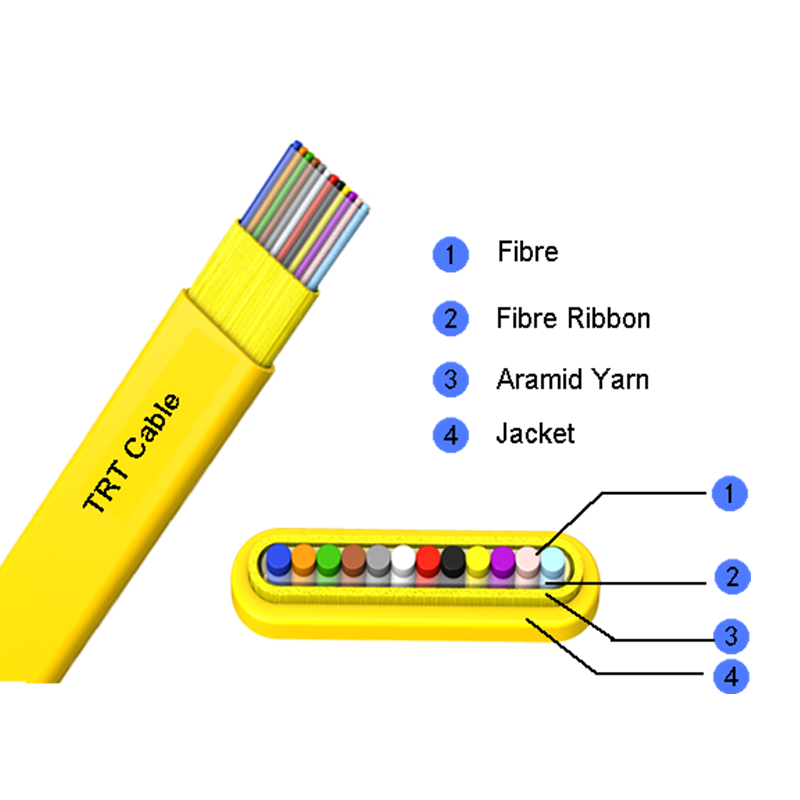
Flat fibre ribbon cable GJDFV/GJDFH is designed with multiple optical fibers aligned in a single, flat plane. Unlike round fiber cables, which bundle fibers in a cylindrical sheath, flat ribbon cables organize fibers side by side. This design allows for higher density cabling, simpler management, and often a more straightforward pathway routing.
The main advantage of the flat ribbon configuration lies in its ability to facilitate high-density connections, especially in environments like data centers, telecommunications rooms, and large-scale network installations. By arranging fibers in a ribbon format, technicians can handle multiple fibers simultaneously, reducing the time required for splicing, termination, and testing.
Design differences between flat fibre ribbon cable GJDFV/GJDFH and round fiber cables
The structural distinction between flat fibre ribbon cable GJDFV/GJDFH and round fiber cables significantly impacts installation workflows. Round cables encapsulate fibers in a circular sheath, which provides flexibility but can increase the complexity of managing multiple fibers. In contrast, flat ribbon cables present the following features:
- Aligned fiber arrangement: Fibers are laid out side by side in a ribbon, simplifying identification and connection.
- Reduced bulk: Flat cables often occupy less space compared to round cables with an equivalent fiber count.
- Enhanced manageability: The flat design reduces fiber twisting and tangling during installation.
These design characteristics contribute to faster, more organized deployments, particularly when handling multiple fibers at once.
Installation advantages of flat fibre ribbon cable GJDFV/GJDFH
One of the most notable benefits of flat fibre ribbon cable GJDFV/GJDFH is its impact on installation efficiency. Several factors contribute to this advantage:
- Simplified splicing: Flat fiber ribbons allow for mass fusion splicing, where multiple fibers are spliced in a single operation. This reduces labor time and potential errors compared to individual splicing of round cables.
- Easier routing and management: The flat, compact design enables technicians to route cables through tight pathways, ducts, and trays with minimal bending stress.
- Fiber identification: The side-by-side layout of fibers in the ribbon simplifies labeling and reduces the risk of cross-connection.
- High-density deployments: Data centers and telecom networks often require high fiber counts. Flat ribbon cables facilitate high-density termination panels without requiring additional space.
These factors collectively improve overall installation speed and reduce operational costs over the life of the network.
Challenges and considerations for installation
While flat fibre ribbon cable GJDFV/GJDFH offers multiple advantages, certain installation considerations must be addressed:
- Bend radius sensitivity: Ribbon fibers are more sensitive to tight bends than some round cables, so proper handling is essential.
- Cable protection: Flat cables may require protective trays or conduits in areas where mechanical stress is high.
- Connector compatibility: Installation teams must ensure connectors are compatible with the ribbon format, as not all standard connectors can accommodate multiple fibers simultaneously.
Understanding these factors ensures that technicians can maximize the installation benefits of flat fiber ribbons while mitigating potential risks.
Comparison of installation workflows
Comparing flat fibre ribbon cable GJDFV/GJDFH and round fiber cables highlights clear differences in workflow efficiency:
| Feature | Flat Fibre Ribbon Cable GJDFV/GJDFH | Round Fiber Cable |
|---|---|---|
| Splicing | Mass fusion splicing reduces time | Individual splicing for each fiber |
| Space efficiency | Compact, supports high-density panels | Bulky, may require additional panel space |
| Fiber identification | Easy with side-by-side layout | More complex, prone to mislabeling |
| Routing | Flat design minimizes twisting | Twisting may occur during bends |
| Installation speed | Faster for large fiber counts | Slower, more labor-intensive |
From this table, it is evident that flat fibre ribbon cable GJDFV/GJDFH offers notable improvements in speed, organization, and density management.
Technical considerations affecting installation ease
Installation efficiency for flat fibre ribbon cable GJDFV/GJDFH also depends on technical specifications, which buyers and network planners should consider:
- Fiber type: Single-mode fibers are typically used for long-distance telecom networks, while multi-mode fibers are common in data centers. The choice affects splicing techniques and termination options.
- Cable jacket material: Different jacket materials provide varying levels of flexibility, mechanical protection, and flame resistance. Selecting the right jacket ensures easier handling during installation.
- Fiber count: Higher fiber counts can enhance network capacity but may require specialized equipment for splicing and management.
- Environmental conditions: Indoor vs. outdoor deployments may affect cable selection. Flat ribbon cables designed for outdoor use often include UV-resistant or water-blocking layers to maintain integrity.
These factors collectively determine how smoothly flat fibre ribbon cable GJDFV/GJDFH can be installed and maintained.
Industry applications and adoption
The installation benefits of flat fibre ribbon cable GJDFV/GJDFH have contributed to its growing adoption in multiple sectors:
- Data centers: High-density network panels benefit from the compact and organized nature of flat ribbon cables.
- Telecommunications: Long-haul and metro networks utilize mass fusion splicing to reduce labor time and improve connection reliability.
- Enterprise networks: Large campuses or industrial networks benefit from simplified routing and fiber identification.
By reducing installation time and supporting high fiber density, flat ribbon cables are increasingly preferred in scenarios where efficiency and scalability are critical.
Best practices for installing flat fibre ribbon cable GJDFV/GJDFH
To ensure successful deployment, the following best practices are recommended:
- Use mass fusion splicing equipment: This reduces labor time and improves uniformity across fibers.
- Maintain proper bend radius: Avoid tight bends to prevent microbending losses or fiber damage.
- Label fibers clearly: Utilize industry-standard color coding for easy identification.
- Protect cables during routing: Use trays or conduits to minimize mechanical stress and maintain organization.
- Plan for future expansion: Incorporate additional pathways or slack to support network growth without re-routing cables.
Adhering to these practices ensures that the benefits of flat fibre ribbon cable GJDFV/GJDFH are fully realized.
Comparing long-term installation and maintenance
While the initial installation of flat fibre ribbon cable GJDFV/GJDFH is faster, its advantages extend to long-term maintenance:
- Simplified troubleshooting: Side-by-side fibers make tracing and identifying faults faster than in round cables.
- Reduced cable congestion: Flat design occupies less space, minimizing conflicts in crowded cable trays.
- Ease of upgrades: Adding new fibers or replacing faulty sections can be done efficiently with minimal disruption.
Overall, these factors improve operational reliability and reduce the total cost of ownership for network operators.
Conclusion
Flat fibre ribbon cable GJDFV/GJDFH offers a significant advantage over traditional round fiber cables when it comes to installation ease. Its flat, side-by-side fiber arrangement facilitates faster splicing, easier routing, and simplified fiber identification, making it ideal for high-density network environments such as data centers and telecom networks. Although care must be taken regarding bend radius, cable protection, and connector compatibility, the benefits in installation efficiency, long-term maintenance, and space management are substantial. For organizations seeking to optimize deployment speed and network scalability, flat fibre ribbon cable GJDFV/GJDFH provides a clear, practical solution that aligns with industry best practices.
 Address:Zhong'an Road, Puzhuang Town, Suzhou City, Jiangsu Prov., China
 Phone:+86-189 1350 1815
 Tel:+86-512-66392923
 Fax:+86-512-66383830
 Email:[email protected]
 Wechat: xiaobin18913501815
 whatsapp: +86 18913501815

 0
0